ENGLISH

March 9, 2026
Moisture absorbents are often used to protect electronic devices from the effects of humidity and condensation.
In waterproof electrical boxes or electronic equipment exposed to humid environments, water vapor can gradually accumulate and cause damage.
Several solutions exist to limit these risks: protective varnish, internal heating or moisture absorbent desiccants.
But not all of these solutions are equally effective, especially when the devices are subject to significant variations in temperature and humidity.
The deposit of a tropicalization varnish on printed circuits protects electronic components against:
These varnishes are generally polymers such as:
They are applied in a very thin layer (a few tens of micrometers) directly to the surface of printed circuits.
However, this solution has several limitations.
Les thermal expansion coefficients solder joints are very different from those of varnishes. When a device is subject to temperature cycles, this generates mechanical stress that can damage the protection.
These thermal variations may come from:
However, it is precisely these rapid thermal variations that promote the appearance of condensation in electronic boxes. In addition, tropicalization protects printed circuits but does not prevent condensation from damaging other system components.
Another approach is to install a heating element inside the case.
The aim is to increase the internal temperature slightly in order to reduce theRelative humidity and limit condensation.
This solution is sometimes used in some outdoor electrical boxes.
However, it has several constraints:
We also find pressure compensating plugs, sometimes called balance plugs.
They are often presented as solutions anti-condensation for electrical boxes. In reality, their main function is to reduce mechanical stress on gaskets when the internal pressure varies. They therefore make it possible to limit the wear of the joints, but do not have a direct effect on condensation. So Sponge researched the effectiveness of this product: "Pressure-compensating plugs: role and limitations"
The silica gel Is one of moisture absorbents the most common.
This desiccating material adsorbs water vapor contained in the air and is widely used in the form of:
In a perfectly airtight housing, silica gel can be very effective in reducing humidity.
However, it has several important limitations.
Its adsorption capacity decreases sharply when Relative humidity exceeds about 70%. In this case, it can quickly become saturated and lose its effectiveness.
In addition, silica gel bags contain mobile beads. In equipment subject to movement or vibration, these bags can move and damage the internal components of the case.
The patented product AS-B is a moisture absorbent designed to avoid condensation under particularly demanding conditions:
Unlike some conventional desiccants, it maintains a high adsorption capacity even when the relative humidity is high.
The AS-B product has several advantages:
It acts like a passive humidity controller, capable of stabilizing humidity in a waterproof electrical box. This solution works without energy and without maintenance.
.png)
The AS-B product can also reduce the risks in case ofintrusion of liquid water into a housing.
This can happen when the gaskets deteriorate over time.
In this case, the adsorbent material accelerates theevaporation of liquid water and facilitates the extraction of moisture present in the volume of the case.
The AS-B material has been designed to withstand extreme conditions.
Laboratory tests have shown that it can work in environments between:
No significant degradation was observed under these conditions.
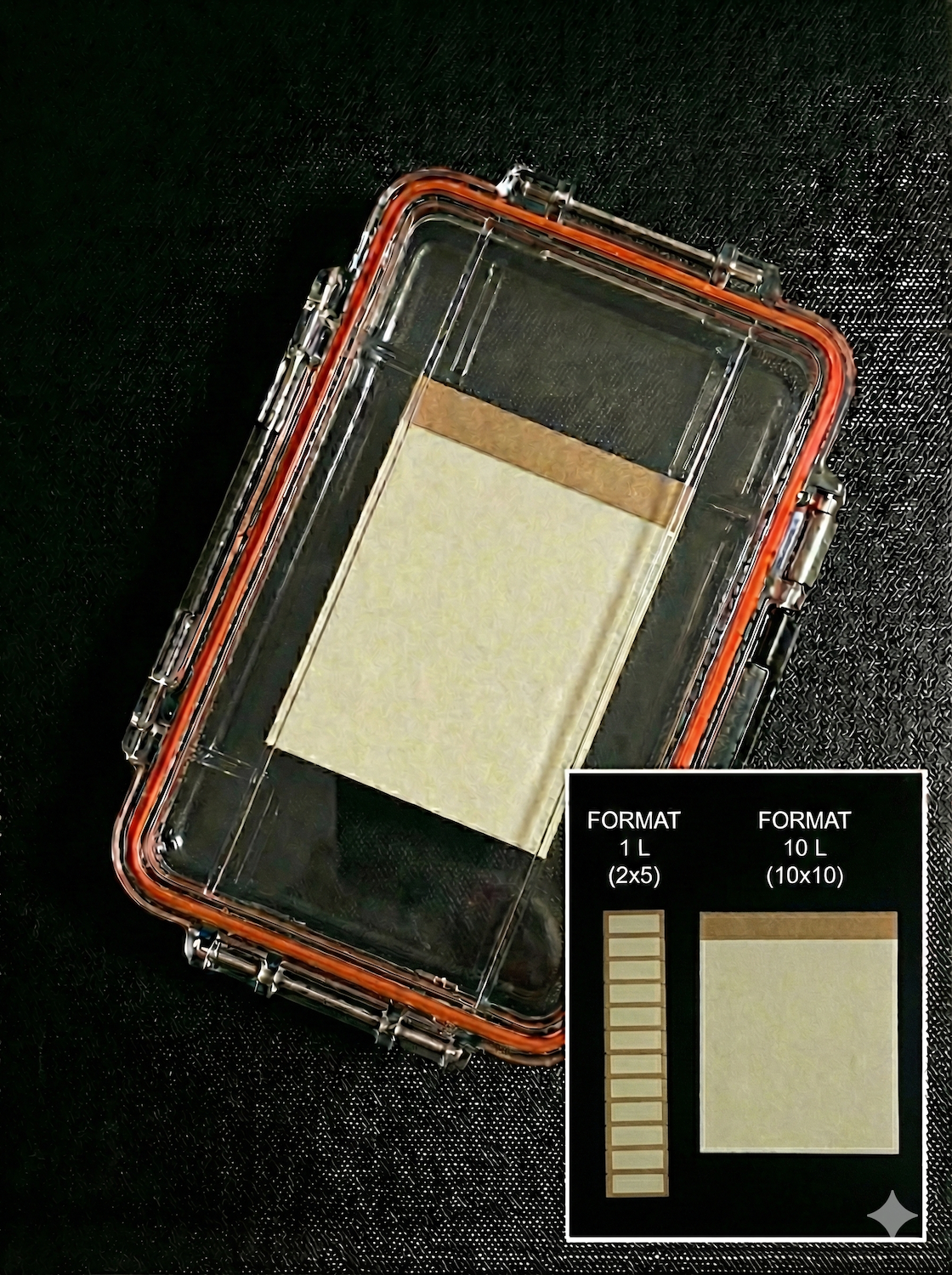
Les AS-B labels are designed to be easily integrated into electronic equipment.
They are:
This solution makes it easy to integrate a absorbing moisture directly into the appliance.
The humidity in an electronic device is a structural problem:
Under these conditions, the use ofmoisture absorbents suitable for electronic boxes is often essential to avoid the deterioration of equipment.
The product Air Sponge AS-B constitutes a sustainable and passive solution to ensure a internal humidity control, especially in demanding industrial or outdoor environments.