ENGLISH

December 11, 2025
La Dew point temperature corresponds to the temperature at which the air becomes saturated with water vapor and begins to produce condensation.
At this very moment, the relative humidity reaches 100%, and the water vapor in the air is transformed into droplets. It is this phenomenon that causes dew at sunrise or the appearance of humidity on a cold surface.
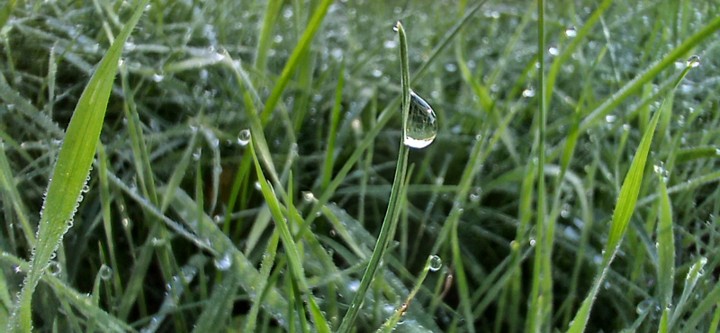
Dew usually occurs when the air cools during the night.
At sunrise, surfaces (plants, roofs, outdoor objects) are often colder than the ambient air.
When the air temperature drops to dew point, the water in it condenses — this is the appearance of dew.
The same principle explains condensation inside homes: if a wall (wall, window, tile) is colder than the dew point temperature, water settles on it.
In reality, the calculation is based on scientific equations that link:
Instead of detailing the formulas, let's remember this:
👉 If the air contains a certain amount of water vapor, we can determine at what temperature this water will condense by comparing this value to water saturation data.
In a room at 20°C and 50% relative humidity :
This means that:
➡️ If a surface of the room falls to 9.3°C, there will be condensation on it.
This is exactly what happens on cold walls, windows in winter or thermal bridges.
Understanding this temperature allows you to:
As soon as a surface is colder than the dew point → condensation occurs.
La condensing interior depends on two factors:
By reducing this ambient humidity, we decrease the probability that the air will reach its dew point.
Air Sponge is based on a patented mesoporous material capable of adsorbing moisture when the level exceeds approximately 60%, then Release it naturally when the air dries up.
Its advantages in a context related to the dew point:
flexible installation (adhesive, magnetic, tape), ideal for areas sensitive to condensation.