ENGLISH

March 9, 2026
In a IP waterproof electrical box, humidity can become a critical problem. Even in a electrical waterproof case, internal condensation may occur during rapid temperature changes.
What is the best then anti-humidity product to effectively protect your equipment?
In the laboratory, we compared two solutions:
One outdoor electrical box Or a IP waterproof housing is not completely isolated fromHumidity in the air.
When a confined volume contains humid air and the temperature drops sharply, we can reach Dew temperature.
Result: Humidity by condensation and the formation of liquid water on the components.
This condensation in an electrical box may result in:
A good anti-condensation product must therefore ensure a genuine humidity control, even under extreme conditions.
We simulated a scenario with maximum risk.
three waterproof electrical boxes IP65, equipped with humidity sensors, have been tested:
Both adsorbents were preconditioned in the laboratory atmosphere.

To quickly generate a very high relative humidity, a cup containing 1 g of water is placed in each case.

After 3:30:
This scenario reproduces the real conditions of a outdoor electrical box subject to significant climatic variations.
THEHumidity indicator built-in shows that:

Silica gel quickly loses its effectiveness when the humidity becomes very high.
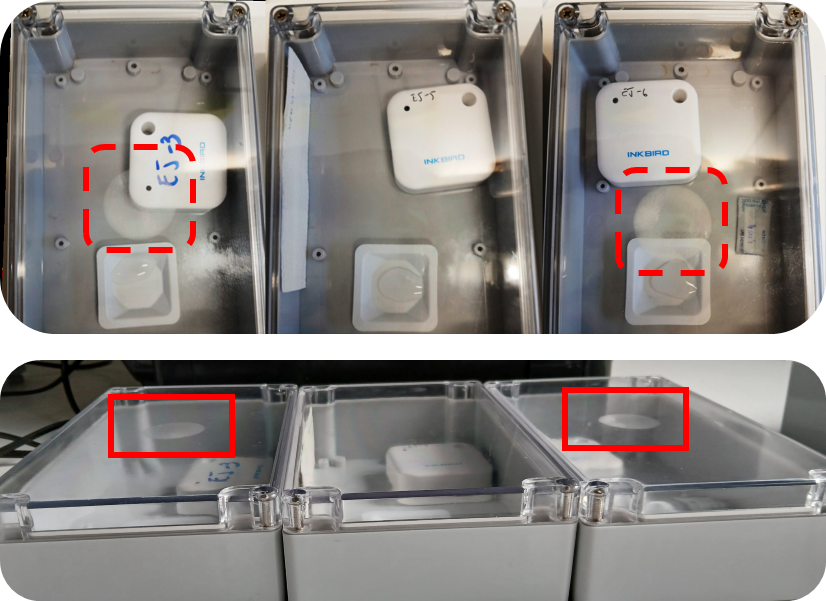
Silica gel is rapidly saturated. Once saturated, it no longer insures any humidity control.So Sponge on the contrary maintains a high adsorption capacity even at high Ambient humidity.
The silica gel is a conventional desiccant (see Definition of desiccant).
It works properly at moderate humidity.
But at very high humidity:
It should also be noted that the anti-humidity bags or dehumidifier bags based on silica are sized for small volumes and not for environments subject to severe thermal cycles.
Unlike silica gel:
It acts like a passive humidity controller, avoiding reaching the critical condensation threshold.
For a IP electrical box, especially in an outdoor environment:
Our AS-B labels prevent condensation in IP boxes subject to extreme weather conditions.
Unlike silica gel, they maintain a high adsorption capacity even at very high humidity.
Do you need to protect your electrical boxes against humidity?
Contact us for a study adapted to your application.