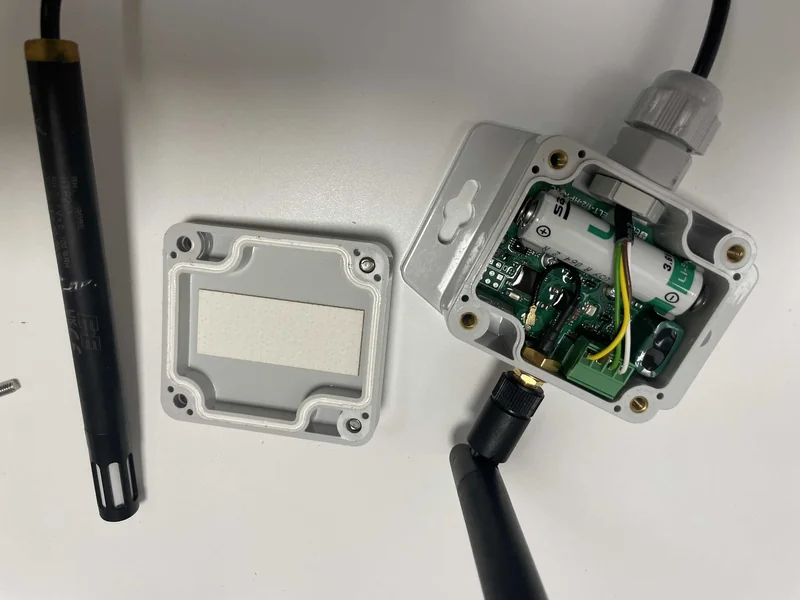
Electronics & IoT Application
Your IoT device is designed to last 7 years on a single battery. Internal condensation cuts that to 18 months — silently, sensor by sensor, across your entire deployed fleet.
The AS-B sticker installs inside sensor housings, LoRaWAN gateways, NB-IoT devices, and embedded modules. It adsorbs water vapor as soon as internal humidity exceeds 60% RH, then regenerates spontaneously when air dries. Zero energy, zero maintenance, lifetime aligned with your equipment.
Why IoT outdoor enclosures suffer from humidity
An outdoor IoT enclosure rated IP65 or IP66 is sealed against liquid water and dust — but not against water vapor. That technical nuance changes everything for equipment expected to operate 5 to 10 years in the field.
During the day, the housing heats up under sun exposure. Internal pressure rises, and air escapes through micro-leaks at gaskets, cable glands, or pressure equalization vents if fitted. At nightfall, temperature drops. Internal pressure drops with it, and outdoor air loaded with water vapor flows back through the same micro-leaks.
Over a few cycles, internal humidity climbs steadily. Once dew point is reached, condensation forms — and IoT outdoor housings are particularly vulnerable: low internal thermal output, high cold-wall surface area relative to internal volume.
An IoT enclosure isn't a camera or an industrial automation cabinet. Three characteristics make condensation proportionally more costly on an IoT fleet:
Long autonomous lifecycle
The enclosure is engineered to last 5 to 10 years without human intervention. Over that span, the factory-installed silica gel pack saturates in 6 months and captures nothing for the remaining 9.5 years.
Dense deployment in inaccessible locations
Sensors deployed in fields, forests, underground parking lots, on streetlight poles, in storm drains, on industrial rooftops. A field service intervention often costs more than the value of the sensor itself.
Zero tolerance on autonomy
A mains-powered enclosure can compensate humidity drift with a heating system. A LoRaWAN sensor on Li-SOCl₂ cannot — every additional milliwatt consumed is a month of autonomy lost.
Three cumulative damages
Internal humidity creates parasitic leakage currents between PCB traces — at levels invisible in active-mode current measurement but cumulative over years. On a typical Li-SOCl₂ 19 Ah battery in a LoRaWAN sensor, these leakages can divide real-world autonomy by 2 to 4×.
On a 10,000-sensor fleet, this means double the battery replacements over 10 years — a hidden cost that appears in no initial spec sheet.
A T°/RH sensor placed inside a housing where internal humidity exceeds 90% RH measures the housing's internal state more than the external environment.
Result: aberrant data sent to the cloud, false alerts, no possibility of remote recalibration, loss of operator confidence. For an air quality sensor, an ambient temperature sensor, a soil moisture probe — the very business value of the measurement collapses.
The AS-B sticker keeps internal humidity below 60% RH — the nominal operating range of virtually all T°/RH sensors on the market.
Liquid water — or even simply condensed vapor on RF components — alters local dielectric properties. Result: progressive antenna mismatch on the integrated antenna and reduced LoRaWAN, NB-IoT, or Sigfox range.
A sensor designed to communicate at 3 km in a semi-rural area can drop to 800 m after a few seasons. The device "works" — it transmits — but with multiplied retry duty cycle and therefore degraded battery autonomy.
Operational cost
For an IoT operator (smart agriculture, smart city, asset tracking, predictive maintenance), real condensation cost is measured in TCO over 10 years.
~40%
of environmental sensor failures
linked to internal condensation (Bosch / IFM / TE diagnostics)
200-1,200 USD
per field service intervention
excluding sensor value (PTC Field Service, SightCall)
2× to 4×
battery replacement frequency
driven by leakage currents from internal humidity
On a fleet of 10,000 LoRaWAN sensors deployed over 5 years:
This is the economy the AS-B sticker protects — for a unit investment of 1 to 5 USD per sensor depending on format.
State of the art
→ Exactly the pain point AS-B solves: spontaneous regeneration, unlimited lifetime.
→ AS-B and pressure vents are complementary: vent for pressure, AS-B for humidity.
→ AS-B and coating are complementary: coating for components, AS-B for internal air.
→ Applicable to mains-powered gateways, incompatible with battery-powered IoT sensors. AS-B is the only viable passive alternative for the battery-powered segment.
Combines the first two solutions. Stacks both individual limitations: pack saturated in months, breather powerless against humidity, plus extra hole in the enclosure.
AS-B Solution
Self-adhesive patch built around a patented mesoporous SRD material, developed at Université Claude Bernard Lyon 1 and IFP Energies Nouvelles, licensed through Pulsalys.
Compact sensor
LoRaWAN, NB-IoT, Sigfox, Wi-SUN
Volume 0.1-0.5 L (3-17 fl oz). AS-B/XS. Apply opposite the exposed T°/RH sensor.
Mid-size IoT device
Asset tracker, level sensor, beacon
Volume 0.5-2 L (17-68 fl oz). AS-B/S. Away from RF components.
LoRaWAN/NB-IoT gateway
Outdoor
Volume 2-10 L (68-338 fl oz). AS-B/M or L. Combine with Gore breather if fitted.
Embedded module
Robot, drone, autonomous vehicle
Volume 0.3-3 L. Severe vibration: reinforced adhesive version (IEC 60068-2-6).
| Operating temperature range | −20 °C to +70 °C (−4 °F to +158 °F) |
| Radio compatibility (sub-GHz, 2.4 GHz) | Yes — LoRaWAN, NB-IoT, LTE-M, Sigfox, Wi-SUN, BLE, Wi-Fi |
| Conformal-coated PCB compatibility | Yes — SRD H₂O-selective, indifferent to organic solvents |
| Onboard T°/RH sensor | Yes — AS-B keeps RH < 60% and preserves accuracy |
| Li-SOCl₂, Li-Po, Li-Ion, NiMH batteries | Yes — no electrochemical interaction |
| PPE on assembly line | None — inert mineral material |
| REACH / RoHS | Compliant / compatible |
| NEMA 4X / NEMA 6 housings | Compatible — same physical principle as IP66 |
| Installation time | < 10 seconds per enclosure, no tools |
Usable capacity over the at-risk range (60-90% RH) is 8 times higher than standard silica gel. Over the typical lifetime of an outdoor IoT sensor (5 to 10 years), the sticker stays active without any intervention.
Animation
Observe how the compared materials behave over a single cycle, then across time.
Cycle
1
Current RH
50%
Cap 0.4 mL/g
⚠ REPLACECap 0.87 mL/g
↻ 0 cycles completeLab test & B2B IoT validations
30 °C → 0 °C (86 °F → 32 °F) ramp over 1 h 20. Three identical IP66 housings:
| Configuration | Result |
|---|---|
| Bare housing (control) | Visible condensation |
| Housing + pressure vent only (Gore Vent) | Visible condensation (matches control) |
| Housing + AS-B sticker | Zero internal condensation |
Weather instrumentation
Leading Nordic manufacturer, outdoor T°/RH instruments deployed worldwide
Connected water quality / pool sensors
French specialist, pool-side measurement, battery longevity at stake
Outdoor agricultural robots
European manufacturer, embedded electronics in open-field exposure
Industrial sensors / automation
German optical sensor manufacturer for automation
FAQ
Yes, and it's an often-underestimated factor. Internal humidity creates parasitic leakage currents between PCB traces. On a Li-SOCl₂ 19 Ah LoRaWAN battery, these leakages can divide real-world autonomy by 2 to 4× without any active-mode current measurement showing anomalies. The AS-B sticker eliminates this source by keeping internal humidity below 60%.
A T°/RH sensor placed inside a housing where internal humidity exceeds 90% RH measures the housing's internal state more than the external environment. The AS-B sticker keeps internal humidity below 60% — the nominal operating range of virtually all T°/RH sensors. The sensor regains its accuracy and the drift disappears.
No — on the contrary. The SRD material is passive and does not absorb radio frequencies. By eliminating condensation on RF components, the sticker prevents the antenna mismatch drift seen on humid enclosures — preserving nominal radio range over time.
Yes. The AS-B sticker coexists without interaction with a conformally coated PCB. SRD is H₂O-selective and indifferent to organic solvents. AS-B and coating are complementary: coating for components, AS-B for internal air.
No. The SRD material is a chemically inert mesoporous aluminum oxide. No electrochemical interaction with Li-SOCl₂, Li-Po, Li-Ion, or NiMH batteries. No risk of accelerated self-discharge, cell swelling, or separator degradation.
Manual or automated placement, < 10 seconds per enclosure. Standard ambient assembly conditions (RH < 80%, room temperature). Storage in original packaging, no dry room required.
Standard MOQ: 5,000 units for XS format, 2,500 units for S, M, L. Standard lead time: 6 to 8 weeks after order confirmation. Express on request. Tiered pricing — details on quote page.
Technically yes — the AS-B sticker can be applied during a maintenance operation. But condensation accumulated over previous years may have already damaged certain components. Retrofit AS-B prevents further degradation but does not repair the past.
Evaluation
Test the AS-B sticker on your own sensors or gateways. So Sponge provides free samples for B2B technical evaluation.