Technology

A self-regenerating mesoporous material

Born from research on transition aluminas, patented and industrialised to regulate humidity with no energy and no maintenance.

×8

more effective than silica gel
in the risk zone (60-90% RH)

0 W

energy
consumption

cycles without
replacement

The innovation

From fundamental research to industrial application

So Sponge technology is based on transition aluminas, mesoporous aluminium oxides whose nanometric pore structure enables capillary condensation of water vapour. Unlike silica gel, which saturates and must be replaced, the So Sponge material regenerates spontaneously at ambient temperature without any energy input.

The properties of this material were discovered by Melaz Tayakout, professor at UCBL, and Elsa Jolimaître, research engineer at IFPEN, who repurposed the thermodynamic properties of transition aluminas — traditionally used as catalytic supports in refining — to create a novel application in humidity regulation.

Patent 2021

via Pulsalys · University of Lyon TTO

SRD material So Sponge

SRD® Technology

How does the SRD® material regulate humidity?

The SRD (Self-Regenerating Desiccant) material exploits capillary condensation in its mesoporous structure. The hysteresis between the adsorption and desorption curves creates a self-sustaining regulation cycle — without energy or intervention.

Adsorption / desorption isotherm of SRD material

0 0.2 0.4 0.6 0.8 0.9 0 20 40 60 80 100 Water adsorbed (mL/g) Relative humidity (%) Adsorption Desorption Regulation zone 65–99% RH Adsorption Desorption SRD >60% SRD >80% Adsorption (fine pores) Desorption
1

Adsorption

When relative humidity exceeds the activation threshold, the mesoporous material captures water vapour through capillary condensation.

2

Regulation

Internal humidity is maintained below the condensation threshold. Components remain protected.

3

Regeneration

When the air dries out, the material naturally releases the adsorbed water. The cycle repeats indefinitely.

The material

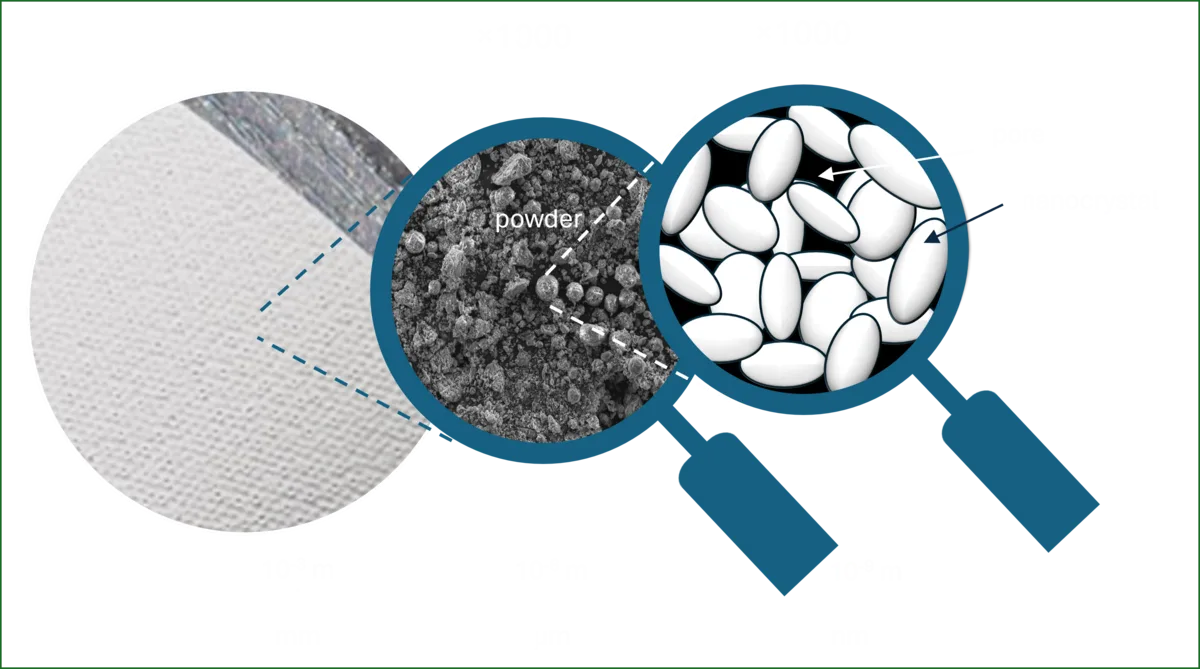
A structure organised across multiple scales

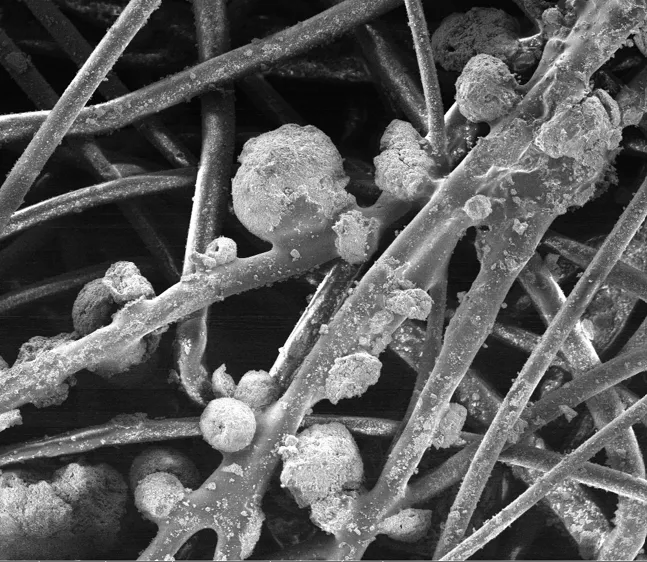
So Sponge products are made from a chemically neutral mineral material, organised across multiple size scales. It is this architecture that gives the material its exceptional adsorption capacity.

nm

Nanocrystals

The base unit of the material, at nanometric scale.

µm

Micrometric powder

Formed by aggregation of nanocrystals.

mm

Millimetric coating

The space between nanocrystals forms the active porosity for adsorption.

Multi-scale structure of So Sponge material: fabric (mm) → powder (µm) → nanocrystals (nm)

Comparison

SRD vs traditional desiccants

Why SRD material replaces conventional desiccants in humidity regulation applications.

Criterion SRD So Sponge Silica gel Zeolite CaCl₂
Regeneration Spontaneous Heating required Heating required Non-reversible
Energy 0 W 100–300 °C 200–350 °C N/A (disposable)
Lifespan Unlimited A few cycles A few cycles Single use
Maintenance None Replacement Replacement Replacement
Activation threshold ~60% RH ~20% RH ~10% RH ~30% RH
Capacity (60–90% RH) ×8 risk zone Baseline ~×2 vs silica ~×3 vs silica

Animation

Silica gel vs SRD: adsorption isotherms under humidity cycling

Observe how the compared materials behave over a single cycle, then across time.

0.9 0.8 0.7 0.6 0.5 0.4 0.3 0.2 0.1 0 0 20 40 60 80 100 Relative humidity (%) Water adsorbed (mL/g) Cap 0.4 mL/g Silica accumulated: 0.00 mL/g SRD current load: 0.00 mL/g Silica gel (isotherm) SRD (isotherm)
Scrub timeline slow-mo
↤ cycle 1 slow-mo fast cycles →

Cycle

1

Current RH

50%

Silica gel saturation 0%

Cap 0.4 mL/g

⚠ REPLACE
SRD saturation 5%

Cap 0.87 mL/g

0 cycles complete

Further reading

Related technical concepts

From material to products

SRD material comes in two complementary ranges: a passive range requiring no energy and an active range with forced-cycle ventilation.