Gore-Tex vent vs SRD AS-B against condensation
Key takeaways — what this test demonstrates
- 🔴 A Gore-Tex pressure compensator does not stop condensation in an IP66 enclosure. In our test, the box equipped with a pressure compensator condensed exactly like the bare control box.
- 🟢 Only the SRD AS-B sticker prevents condensation by adsorbing water vapor before it reaches the dew point.
- 💡 The two devices do not perform the same function. A pressure compensator equalizes internal pressure and preserves seals over time — it has no demonstrated action on internal humidity. The SRD, in contrast, addresses humidity continuously.
The confusion to dispel: pressure compensator ≠ desiccant
When specifying an IP65 or IP66 enclosure for an outdoor environment, two families of accessories are routinely presented as alternatives to “manage humidity”:
- pressure compensation vents (Gore-Tex membranes and equivalents),
- internal desiccants such as silica gel sachets or mesoporous-material stickers (SRD AS-B sticker).
These two devices are sometimes sold as substitutes. They are not: they address two different physical phenomena and are not interchangeable. To demonstrate this experimentally, we ran a comparative test between a Gore-Tex pressure compensation vent and the AS-B sticker on IP66 enclosures placed in a climate chamber.
What a Gore-Tex pressure compensator does — and does not do
A pressure compensation vent is a microporous hydrophobic membrane (typically expanded PTFE, Gore-Tex type). Its actual function: allow gases to pass freely to equalize internal pressure against external temperature variations, while blocking liquid water. This is useful to preserve enclosure seals from mechanical fatigue caused by pressure cycling over the very long term (5-10 years).
Its fundamental physical limit: the membrane does not distinguish dry air from humid air. Water vapor crosses the membrane just as freely as air. A pressure compensator therefore has no preventive action on internal condensation. Worse: if outside air is more humid than inside air, the vent accelerates vapor entry into the enclosure.
These accessories are nonetheless regularly promoted as “anti-condensation solutions”. The test below establishes visually that this promise is not kept.
What an SRD AS-B sticker does
The AS-B sticker is built around a mesoporous SRD (Self-Regenerating Desiccant) material that adsorbs water vapor by capillary condensation as soon as relative humidity rises above 60% — precisely the zone preceding condensation. When the ambient air dries, the material regenerates spontaneously without energy input. Its function is fundamentally different from the vent: it does not manage pressure, it captures humidity before it condenses.
For the full physics of IP65 enclosure breathing and AS-B sizing, see our dedicated article: the breathing of IP65 enclosures and the time constant τ.
Test protocol: 3 IP66 enclosures in a climate chamber
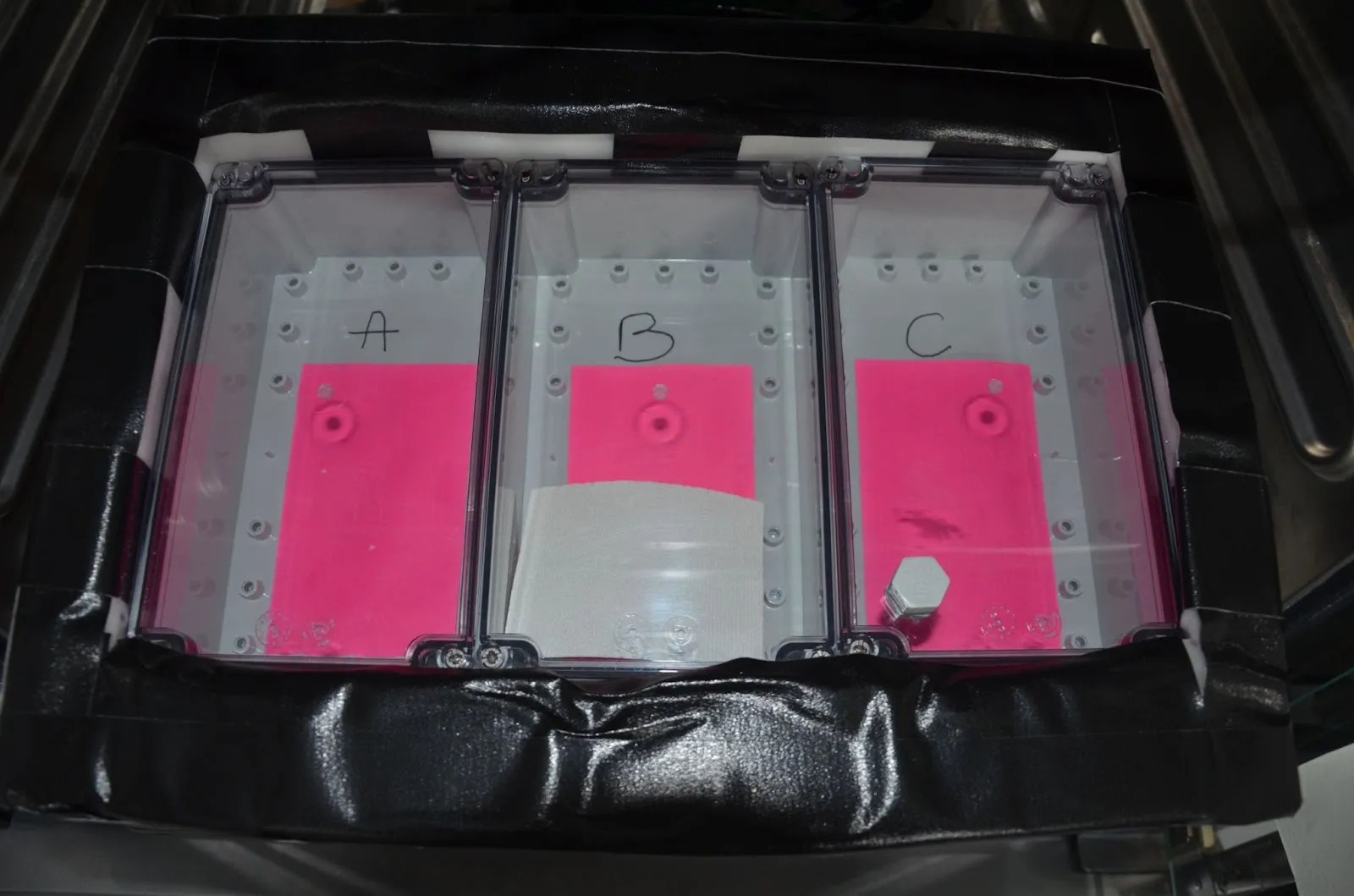
Three hermetic IP66 enclosures (IP rating for liquid water sealing) were prepared:
- Box A — bare control (reference, no device)
- Box B — SRD AS-B sticker affixed to the inner wall
- Box C — pressure compensation vent (Gore-Tex type)
The three boxes were placed inside a foam insulation jacket allowing thermal exchanges only through the glass face — which optimizes condensation visualization. Visible mist on the glass is a direct indicator of dew point being reached inside the enclosure.
Figure 1: IP66 enclosures bare (A), with AS-B sticker (B), and with pressure compensation vent (C), placed in foam insulation.
Initial humid environment simulation
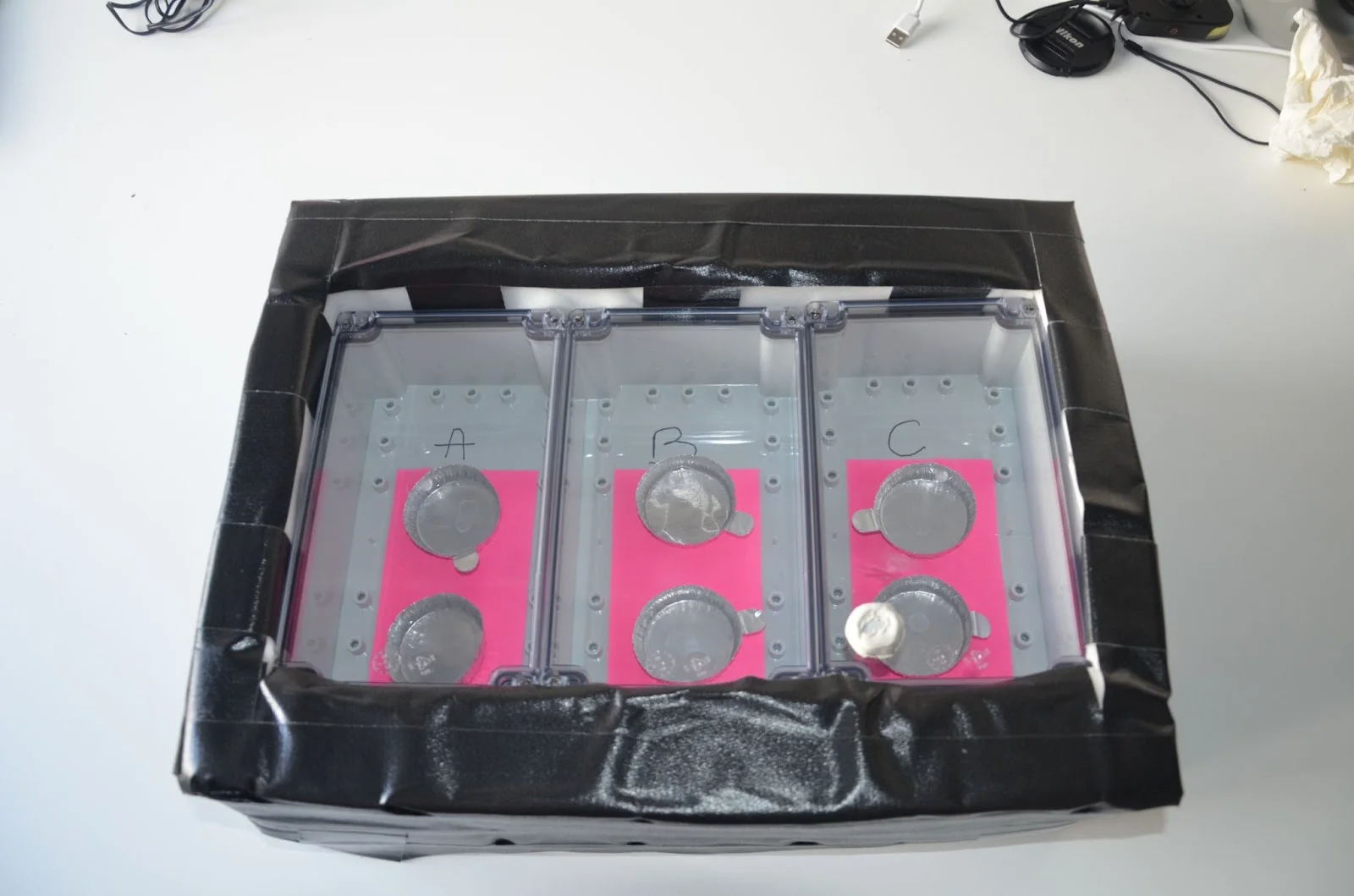
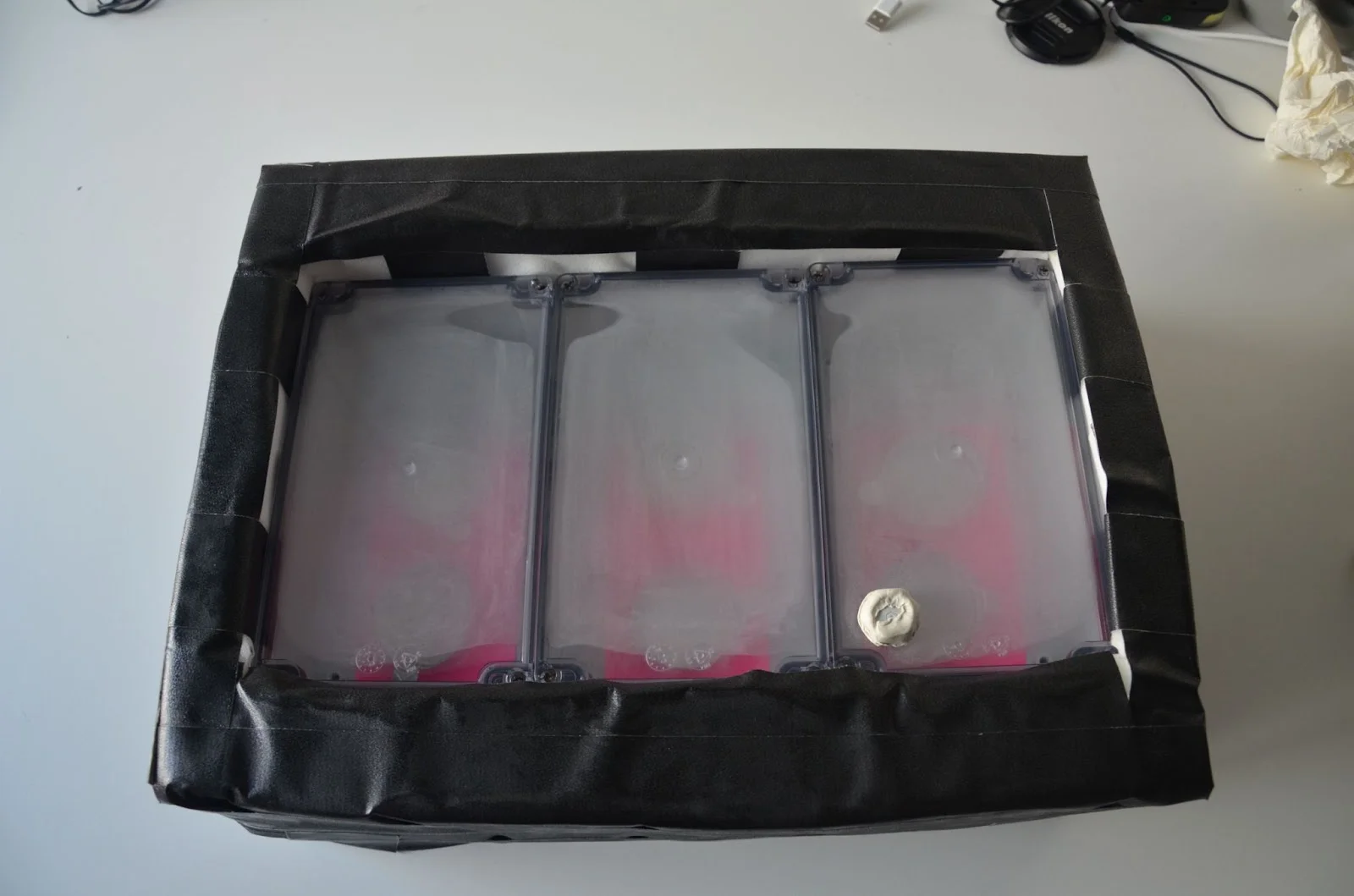
To generate identical humid air in all three boxes prior to the final test, a water dish was placed in each (with the box C compensator temporarily sealed with adhesive putty to equalize initial conditions). Boxes were first held at 30 °C for 30 min in the climate chamber to evaporate the water, then brought to 0 °C for 30 min to trigger condensation on the glass face and confirm that all three enclosures contained vapor-saturated air.
Figure 2: Initial conditions — water dishes placed in the 3 boxes. Figure 3: Mist formed in all 3 boxes after dropping to 0 °C — interior atmosphere saturation confirmed.
Final test: 30°C → 0°C ramp over 1h20
Once initial conditions were validated, the dishes were removed, the AS-B sticker was installed in box B, and the adhesive putty was removed from box C’s compensator. The three boxes were warmed back to 30 °C for 30 min to evaporate residual mist, then introduced simultaneously into a chamber programmed to ramp from 30 °C down to 0 °C over 1h20. The experiment was filmed (Nikon D5100) to track mist appearance in real time.
Results: 2 out of 3 enclosures condensed
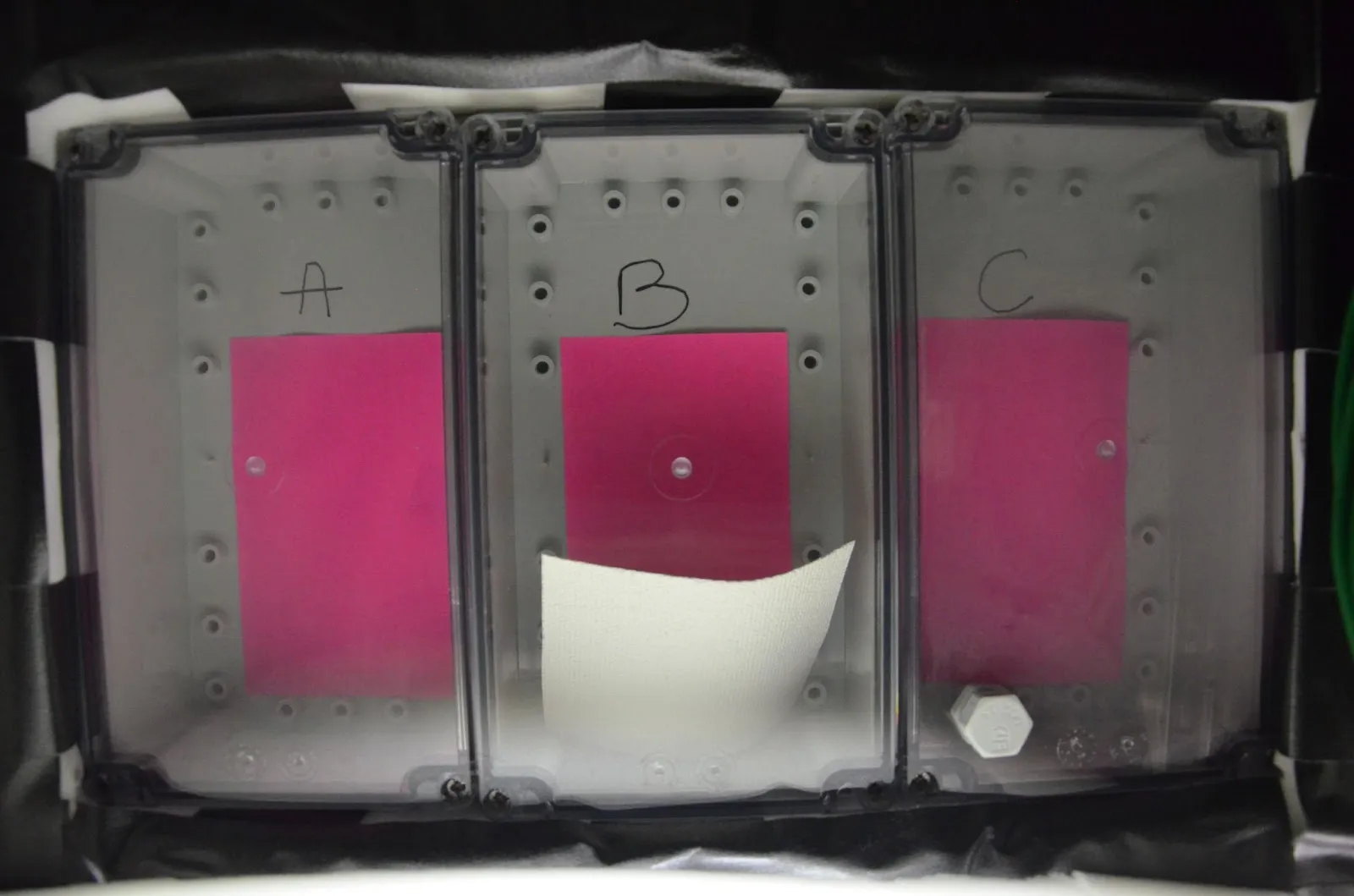
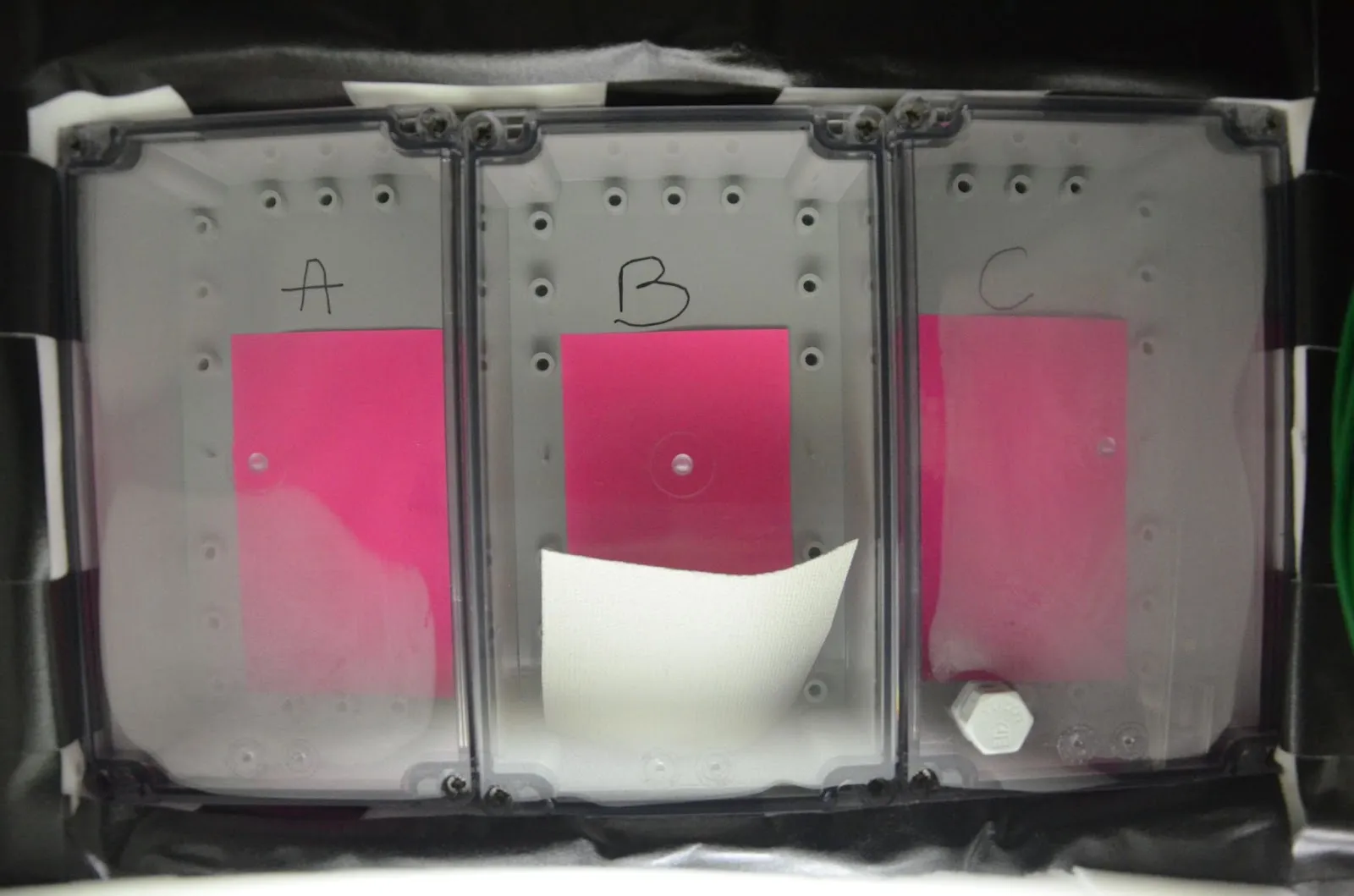
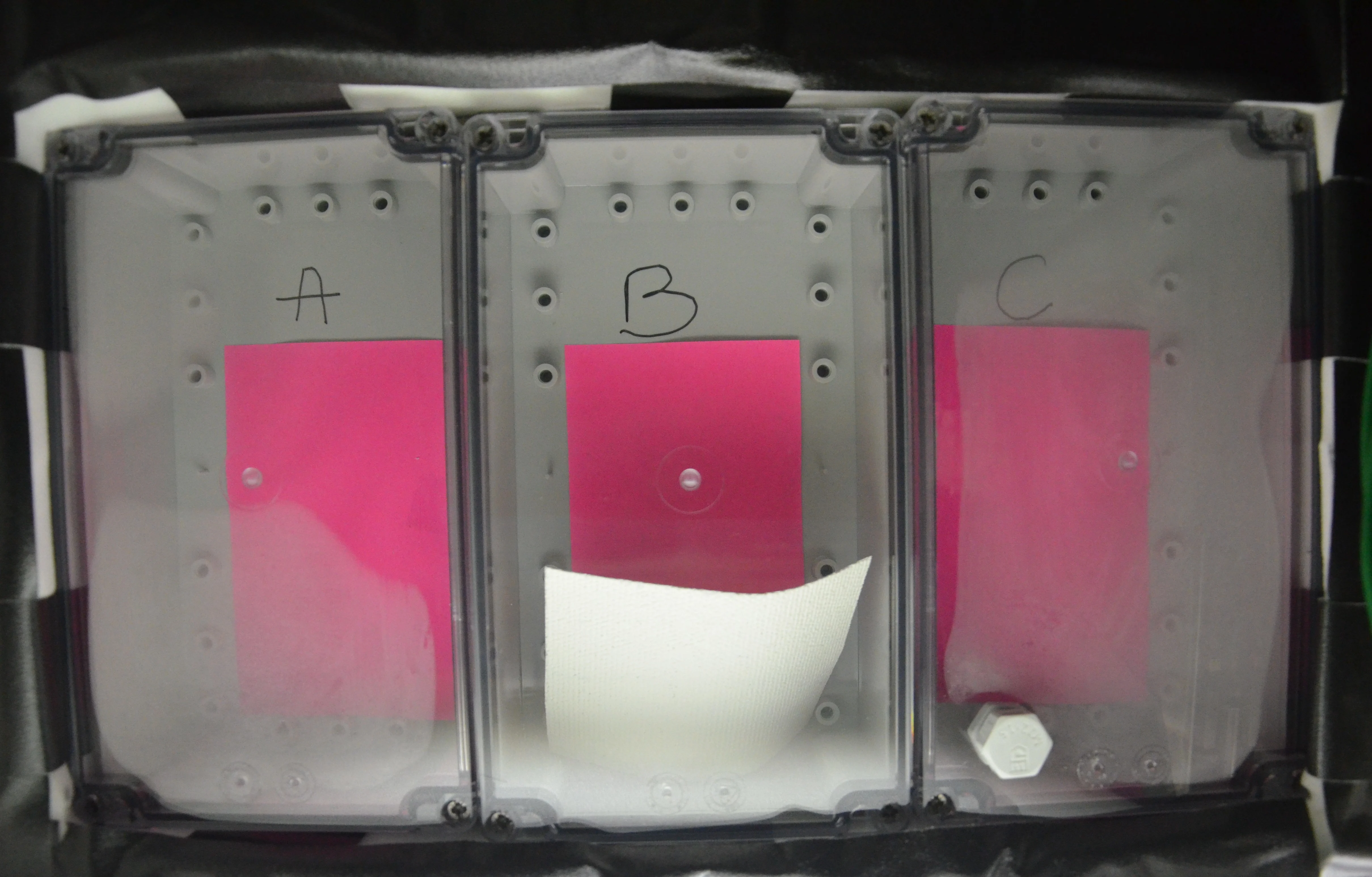
Upon reaching 0 °C, the photos show unambiguously:
- 🔴 Box A (bare control) — heavy mist on the glass face
- 🔴 Box C (Gore-Tex pressure compensator) — heavy mist on the glass face, result indistinguishable from the bare control
- 🟢 Box B (AS-B sticker) — perfectly clear glass face, no mist formed
The temperature drop created a cold point on the glass face. The dew point was crossed in boxes A and C, triggering condensation. In box B, the AS-B sticker adsorbed water vapor as the temperature dropped, keeping internal relative humidity below the saturation threshold and preventing any droplet formation.
Figure 4: Before (left) and after (right) the 30°C → 0°C cycle. Box B (AS-B) is the only one without condensation.
Comparative summary
| Criterion | Pressure compensator (Gore-Tex) | SRD AS-B sticker |
|---|---|---|
| Primary function | Equalize internal pressure | Adsorb internal water vapor |
| Mechanism | Microporous gas-permeable membrane | Capillary condensation in mesopores |
| Blocks incoming liquid water | ✅ Yes (hydrophobic membrane) | n/a (internal action) |
| Blocks incoming water vapor | ❌ No — vapor passes freely | n/a (internal action) |
| Adsorbs internal vapor | ❌ No | ✅ Yes, from 60% RH |
| Prevents internal condensation | ❌ No (test above confirms) | ✅ Yes (test above confirms) |
| Preserves seals long-term | ✅ Yes (pressure equalization) | ❌ No (internal action only) |
| Energy required | None | None |
| Maintenance | None | None (SRD self-regenerating) |
| Ideal use case | Highly sealed enclosures undergoing strong thermal cycling over 5-10 years | IP65+ enclosures exposed to internal condensation risk |
When to use one, the other, or both
The two devices do not compete — they address two different problems:
- If your dominant risk is premature seal aging from pressure cycling (very long term, high thermal amplitude environments) → the pressure compensator has its place.
- If your dominant risk is internal condensation on electronics (corrosion, sensor drift, dielectric breakdown) → only an internal desiccant like the SRD AS-B sticker is effective.
- For IP65/IP66 outdoor enclosures with a 10-year lifetime target and sensitive electronics, the two can coexist: the vent mechanically protects the seals, the SRD addresses internal humidity.
Conclusion — two takeaways
-
A pressure compensation vent does not do the same thing as an SRD sticker. They are sometimes sold as alternatives — they are not. The vent manages pressure, the SRD manages humidity. Confusing them in a specification document means risking a protection that does not address the actual problem.
-
The SRD AS-B sticker demonstrably prevents condensation, the pressure compensator has no demonstrated preventive effect on this phenomenon. Our test establishes this visually: the box with the pressure compensator condenses exactly like the bare control box.
To specify your humidity protection on an IP65+ enclosure, request an AS-B quote online or read our deep-dive article « The breathing of IP65 enclosures — why moisture always gets in » which details the physics of vapor diffusion and the analytical sizing of the sticker for your enclosure and climate.