Condensation in industrial IP65/IP67 sensors
The global industrial sensors market is valued at approximately USD 27 billion in 2025 and is projected to reach USD 43 billion by 2030, according to Mordor Intelligence and Straits Research. Over 90% of these sensors now integrate embedded electronics — signal amplification, digital processing, bus communication, or IO-Link interfaces. This shift toward “smart” sensors makes each unit more capable, but also far more vulnerable to a silent threat: internal condensation.
The Problem: Trapped Moisture Inside Sensor Enclosures
Even an IP65- or IP67-rated enclosure is not immune. Sealing keeps liquid water out, but it also traps residual humidity present in the air at the time of assembly. When temperature drops — day/night cycles, cold chain transitions, offshore exposure — this internal moisture condenses directly onto printed circuit boards, connectors, and sensitive components.
The consequences are well known to field engineers:
- Galvanic corrosion of traces and connectors, accelerated in saline or chemical environments.
- Intermittent short circuits causing erratic readings or unplanned shutdowns.
- Silent calibration drift — the sensor continues operating but delivers inaccurate data, arguably the most dangerous failure mode in industrial environments (WFsensors, Vaisala).
- Irreversible degradation of solder joints and vias subjected to repeated wet/dry cycles.
Significant Failure Rates
According to a Perceptive Engineering study (2022) and diagnostics conducted by manufacturers including Bosch, TE Connectivity, and IFM Electronic, internal condensation and trapped humidity account for approximately 40% of environment-related sensor failures. Trace and connector corrosion contributes roughly 25%, and water ingress through faulty cables or seals about 20%. In other words, over 85% of environment-related failures are directly or indirectly linked to moisture.
Failure rates vary by application domain. Consumer-grade IoT sensors (IP20-IP44) show 3–5% humidity-related failure within the first year. Outdoor agricultural sensors reach 8–15% over three years. In offshore or marine environments, the rate climbs to 15–25% over three years, driven by salt-accelerated galvanic corrosion.
Current Solutions and Their Limitations
To address this problem, industrial sensor manufacturers have developed several anti-condensation approaches:
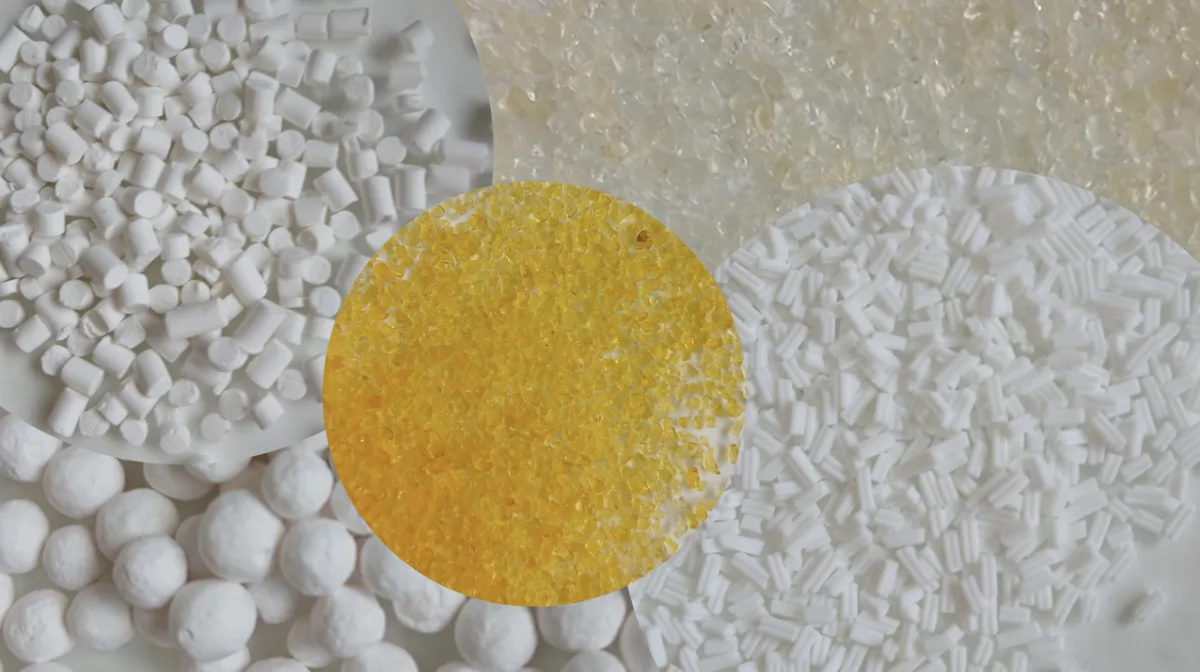
Conventional silica gel remains the most common solution. Integrated as sachets or capsules inside enclosures, it passively adsorbs moisture. Its main drawback: it saturates progressively and loses effectiveness, particularly in the critical zone above 60% relative humidity. Once saturated, it no longer protects the sensor and requires replacement — a costly operation when the sensor is mounted at height, in an ATEX zone, or on offshore infrastructure.
GORE-TEX membranes and hydrophobic coatings provide a barrier against liquid water while allowing some enclosure “breathing.” Vaisala uses them on its HMP/WXT series (IP67-rated) combined with an integrated drying agent. However, these solutions add significant cost and do not address moisture already present inside the enclosure.
Conformal coating (tropicalization varnish) protects PCBs directly. IFM Electronic applies it to its VSE/VSA range, combined with a desiccant at the bottom of the enclosure. Endress+Hauser uses it on its iTEMP and Deltabar series. This approach is effective but increases production costs and lead times.
Dual-envelope enclosures, such as IFM Electronic’s approach — a rigid external plastic housing with a sealed flexible inner envelope — provide good protection but add weight, complexity, and per-unit cost.
The SoSponge Approach: A Self-Regenerating Desiccant for Industrial Sensors
The SoSponge desiccant offers a fundamentally different response to internal condensation. Unlike traditional silica gel, which saturates linearly and irreversibly, the SoSponge material features a specific adsorption/desorption curve that enables partial regeneration during natural thermal cycles.
How the SoSponge Desiccant Works
The principle relies on the physical properties of the SoSponge SRD (Self-Regenerating Desiccant) material. When relative humidity rises inside the sensor enclosure, the material adsorbs water molecules. When temperature increases — due to solar exposure, equipment operation, or industrial thermal cycles — the material releases a portion of the captured moisture (desorption).
This regeneration mechanism is particularly well-suited to environments with pronounced thermal cycling: cold chain logistics, outdoor installations, tunnels, and marine applications. Where conventional silica gel would saturate within weeks, SoSponge maintains protective capacity over significantly longer periods.
Tape Format and Industrial Integration
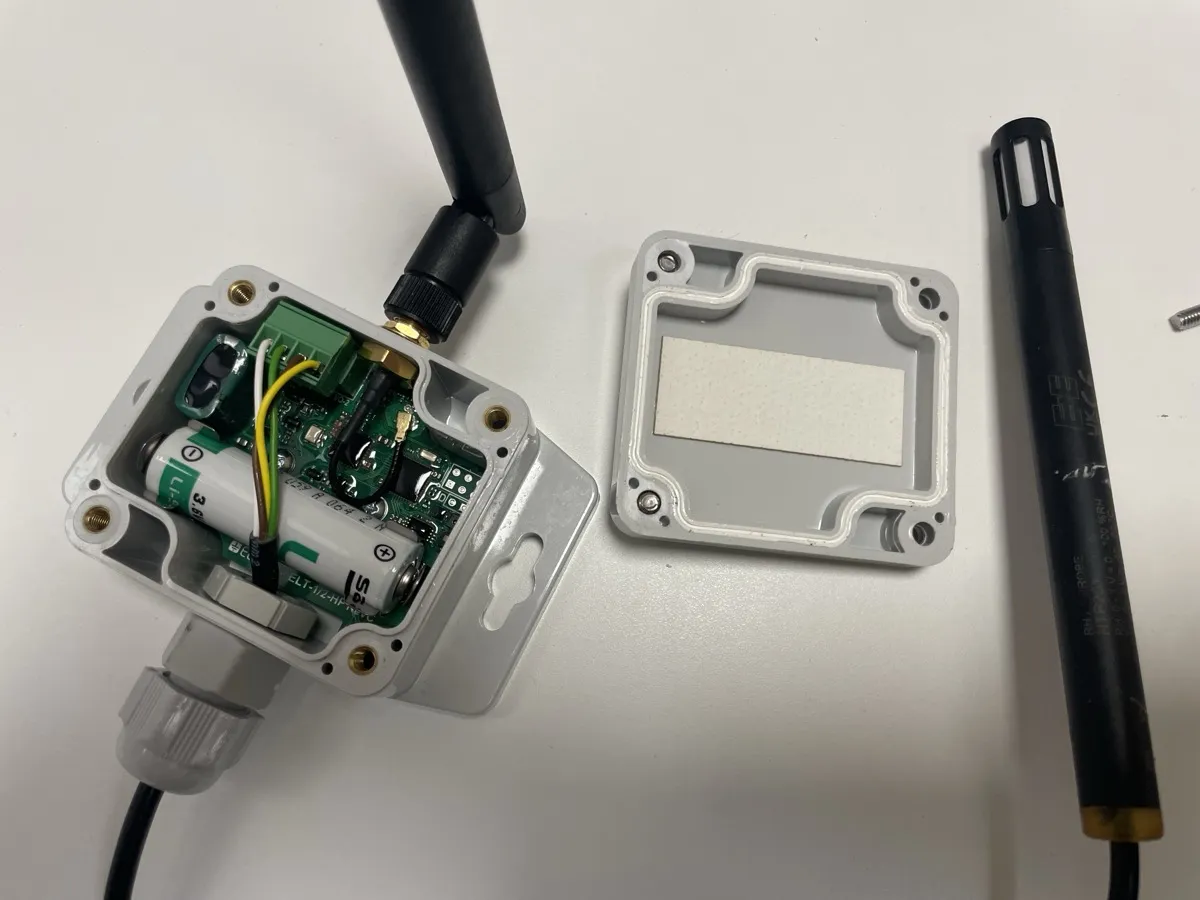
Available as adhesive tape, the SoSponge desiccant integrates easily into existing enclosures without mechanical design changes. This format is compatible with automated assembly lines and does not require a dedicated desiccant compartment — unlike the silica gel sachets used by manufacturers such as Pessl Instruments (METOS & microMETOS stations) or Campbell Scientific (MET One, CR6, CS215 stations).
Biochemical and diagnostic sensors: a demanding special case
Beyond industrial IoT, one sensor family is even more humidity-sensitive: biochemical and diagnostic sensors — the technology behind medical, environmental and safety analyzers. Their failure modes are specific:
- Lateral-flow test strips (immunoassays) lose sensitivity as the membrane absorbs moisture — which is why every diagnostic cassette ships with a desiccant, and why storage humidity is part of the product specification.
- Electrochemical cells drift with relative-humidity cycling: the electrolyte equilibrates with ambient vapor, shifting baseline and calibration.
- Optical measurement windows and sensor chips fog exactly where the signal is read: in a sealed analyzer housing, condensation forms preferentially on the coldest surface — usually the optics.
For these products, humidity control is not an accessory but a design parameter: R&D teams increasingly specify a desiccant at the design stage — inside the instrument housing, the consumable’s packaging, or both. A self-regenerating material changes the equation for the device side: unlike the sachet in a test kit, it protects for the instrument’s whole life without ever being replaced. This is typically what teams evaluate with a first AS-B roll in the lab: capacity, kinetics under their thermal profile, and compliance documentation (REACH, RoHS) for the regulatory file.
Field Validation: Industry Feedback
Market interest in this technology is confirmed by early feedback from major industrial players:
During a prospecting campaign conducted in early 2026 across 33 European industrial sensor manufacturers, several leaders in the fields of industrial automation, environmental measurement, and detection technologies confirmed that internal condensation is a critical and well-identified issue on their products. Some already rely on breathable membrane + conventional desiccant combinations, others on conformal coating or dual-envelope designs — but all acknowledge the limitations of these approaches.
Several of these manufacturers have requested to evaluate SoSponge technology as an alternative to their current solutions, and samples have been provided for testing under real-world conditions.
A High-Growth Market Opportunity
The segment of industrial sensors with embedded electronics is growing rapidly, driven by Industry 4.0, industrial IoT, and predictive maintenance. The market is expected to exceed 4 billion units sold per year by 2030, across all technologies (Precedence Research).
The sectors most exposed to condensation issues — and therefore most receptive to a high-performance desiccant solution — include manufacturing and automotive (~35% of the market), energy and utilities (~20%), chemicals and petrochemicals (~15%), and food/pharmaceutical (~10%).
The trend toward increasingly “intelligent” sensors integrating microcontrollers and edge AI only amplifies the need for moisture protection. The more sophisticated the sensor, the higher the cost of a condensation-related failure.
Conclusion
Internal condensation remains one of the leading causes of industrial sensor failure in outdoor environments or under thermal cycling conditions. Traditional solutions — silica gel, membranes, conformal coating — each have limitations in terms of lifespan, cost, or ease of integration.
The SoSponge desiccant, with its self-regeneration mechanism and tape format designed for industrial integration, offers a credible alternative for sensor manufacturers looking to reduce return rates and improve product reliability under real-world conditions. Early feedback from several European industry leaders confirms market interest in this approach.
Sources:
- Mordor Intelligence & Spherical Insights — Industrial sensors market data 2025–2030
- CI-Services / Pascal Courrier — SoSponge Market Study, March 2026
- Vaisala — Common humidity measurement problems
- WFsensors — How moisture affects sensor elements
- Bulgin — Impacts of moisture in harsh environment electronic design
- Danfoss — Effect of humidity and condensation on power electronics