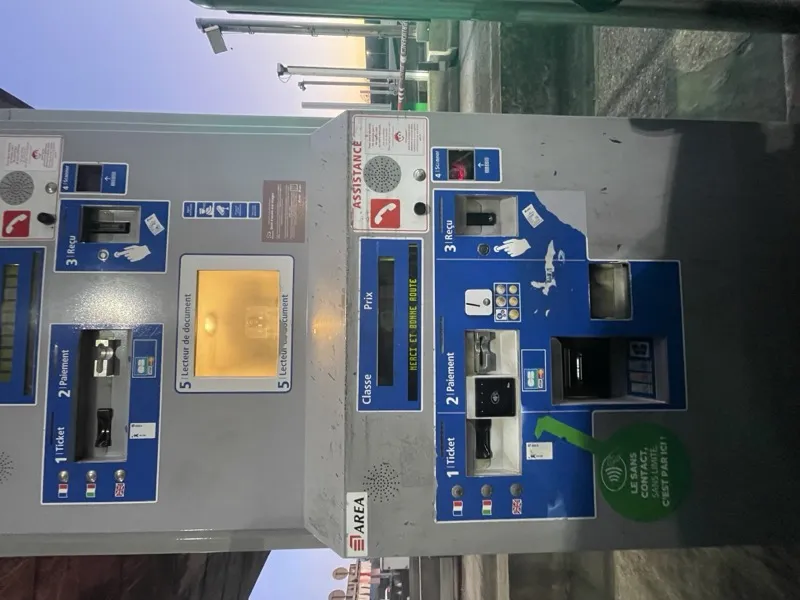
Outdoor payment kiosk IP65

Infrastructure & Storage Application

Outdoor Payment Kiosk Humidity Protection IP65+

An outdoor payment kiosk that refuses a card at 6 a.m. on a winter morning means an emergency intervention, an unhappy user, and — across a fleet — thousands of annual incidents that erode trust and weigh on field service OPEX.

The AS-C tape protects the internal air of your outdoor payment kiosk — parking meters, tollbooths, outdoor ATMs, drive-through terminals, free-flow gantries. Capillary adsorption above 60% RH, spontaneous regeneration. Validated by the a French EV charging operator 85-day field study on 3 outdoor IP65 enclosures — 24,385 measurements winter 2025/2026.

8× usable capacity zone 60-90% RH 0 W consumption — no energy OPEX Compatible with IP65/IP66, IK10, EMV/NFC, banking standards a French EV charging operator 85-day study validated

Why outdoor payment kiosks suffer

Permanent thermal cycling on a critical financial asset

An outdoor payment kiosk — whether a parking meter, manual tollbooth, free-flow gantry, façade-mounted ATM, drive-through QSR terminal, or parking access kiosk — is exposed to a dual stress few outdoor assets cumulate.

Severe permanent thermal cycling. South-facing kiosk in full afternoon sun, dropping sharply at night. Cycle 30-40°C → 0-5°C in 12 hours, 365 days a year. Internal pressure collapses overnight; outdoor air loaded with humidity flows in through micro-leaks at touchscreen gaskets, coin slots, card readers, and service doors.

Critical financial asset on the front line. Outage cost far exceeds the spare part cost — it is a cumulative operational and reputational cost: blocked vehicle (parking), closed lane (tollbooth), interbank-billed SAV (ATM), lost order (drive-through), billing impossible (free-flow).

Three cumulative damages

1. Touchscreen fogging and frosting

Capacitive or resistive touchscreens become inoperative when fogged — finger not recognized, contacts disrupted. Winter morning fog generates recurring SAV calls rarely diagnosed as "internal humidity" but as "screen failure".

2. Corrosion on EMV/NFC card readers, coin mechanisms, ticket printers

Copper/silver/gold contacts of magnetic stripe, EMV chip, and NFC antenna readers oxidize progressively. Read error frequency rises until outright failure. Same for coin mechanisms (optical sensors, solenoids), ticket printers (thermal head, paper sensors).

3. Accelerated aging of embedded payment electronics

Payment controllers (PCI-PTS certified), GSM/4G modules, backup batteries have a nominal lifetime of 7-15 years in dry conditions. In humid environment, divided by 1.5 to 2.

Operational cost

Operational cost across an outdoor kiosk fleet

5,500+

cumulative thermal cycles

Over 15 years of outdoor exposure

$165-550

per remote field intervention

PTC Field Service, SightCall

÷ 1.5 to 2

payment electronics lifetime

When average internal RH > 80%

Several M$

in lost transaction revenue/year

On a multi-thousand-kiosk fleet

On a fleet of 5,000 urban parking meters:

  • Humidity-related failures: ~1-3% per year = 50-150 avoidable interventions/year = $8,000-80,000 OPEX/year
  • Early renewal of ticket printers and EMV readers: several hundred thousand USD over 10 years
  • Lost transaction revenue during outages: not directly quantifiable but real

On a fleet of 1,000 manual tollbooths or free-flow gantries at a highway concessionaire:

  • Critical humidity-related failures: ~2-4% per year = 20-40 major incidents/year
  • Emergency highway intervention cost (safety, lane closure): $550-2,200/incident
  • Impact on contractual SLAs with concession authority

On a fleet of 500 outdoor ATMs:

  • Every payment incident = SAV ticket billed by the interbank network
  • Contractual availability of 99.5% minimum required by major networks (Visa, Mastercard)

State of the art

Why current solutions don't work

Calcium chloride salts (Rubson, Wisedry, Damprid)

Default solution from most kiosk OEMs (Parkeon/Flowbird, IEM, Ducati Energia for meters; NCR, Diebold Nixdorf, Hyosung for ATMs; Kapsch, Q-Free, Vitronic, Conduent, Verra Mobility for tolling).

  • Saturated in 6-12 months on an exposed outdoor kiosk
  • Never replaced once the kiosk is installed (intervention cost, dispersed fleet)
  • Designed for transport and the first year

→ AS-C addresses this exact pain point: spontaneous regeneration aligned with kiosk lifetime.

Pressure equalization vent

Found on modern IP65/IP66 kiosks — recommended to limit mechanical stress on gaskets under thermal cycling.

  • Doesn't control internal humidity: water vapor passes through the membrane
  • The a French EV charging operator 85-day study confirms: on an outdoor IP65 enclosure with breather only, the correlation between internal and external RH stays at 0.54 (vs 0.02 with AS-C)

→ AS-C and pressure vents are complementary: vent for mechanical pressure, AS-C for internal humidity.

Resistive heater + hygrostat

Traditional solution on premium ATMs and meters in very cold areas (Scandinavia, mountain).

  • Consumes 30-150 W (~30% real duty cycle) = significant energy OPEX over a multi-thousand-kiosk fleet
  • Electromechanical component = additional point of failure
  • Generates a thermal load constraining internal thermal balance

→ AS-C can replace or reduce heater duty cycle on new deployments.

Internal climate control (Peltier)

Found on premium outdoor ATMs and free-flow gantries in international highway concessions.

  • Consumes 50-200 W (~30% real duty cycle)
  • Moving component = new point of failure
  • Generates its own condensate to drain (tray + tube that can leak)

→ AS-C delivers passive anti-condensation, no energy, no filter.

Screen defroster (heater behind the panel)

Found on some recent meters and free-flow gantries — heater behind the touchscreen to eliminate morning fog.

  • Treats the symptom (screen fog) not the cause (internal humidity)
  • No effect on card reader, coin mechanism, ticket printer corrosion
  • Doesn't preserve embedded payment electronics

→ AS-C addresses the root cause. Positive collateral on screen fog (dry internal air doesn't condense on the inner surface of the screen).

Choose your format

Which AS-C format for your kiosk type

Kiosk typeInternal volumeRecommended AS-C format
Compact urban parking meter Parkeon Strada, Flowbird CWT30-80 LAS-C tape (sized surface)
Large parking meter with battery + ticket printer80-150 LAS-C tape
Drive-through QSR terminal50-200 LAS-C tape
Façade-mounted ATM NCR SelfServ, Diebold Nixdorf 5500, Hyosung200-500 LAS-C tape (extended surface)
Manual tollbooth operator cabin500 L - 2 m³AS-C tape (multiple meters)
Free-flow electronic gantry overhead + ground cabinet100-400 LAS-C tape
Parking access kiosk entry/exit, badge reader30-100 LAS-C tape
Outdoor information / order kiosk station, airport, stadium50-200 LAS-C tape

Very small volume case (< 30 L): for kiosks or compact payment modules (e.g., outdoor contactless terminals), the AS-B/L sticker (40 cm²) can be considered as alternative. See AS-B.

Integration

How to integrate in practice

On a parking meter

The AS-C tape (5-8 cm width, 30-80 cm length depending on volume) bonds to the inner wall of the main compartment, away from hot components (power supply, GSM/4G modem) and ideally in the upper area (natural vapor accumulation zone). Application in 2-3 minutes per meter on assembly line or during field service.

On a façade-mounted ATM

Apply AS-C tape in the main electronics compartment (separate from the cassette compartment for banking security). Surface sized by volume — typically 100-200 cm² for a 300 L ATM. No intervention on secured compartments or cassettes — integration during routine maintenance, no impact on PCI-PTS certification.

On a free-flow electronic gantry

Apply in two zones: the overhead gantry (LPR cameras, sensors, RFID/DSRC antennas) and the ground cabinet (controller, power, modem). Dedicated surface for each compartment.

On a manual tollbooth (operator cabin)

Multiple meters of AS-C tape are integrated on the cabin's inner walls, ideally distributed: operator dashboard area + power supply area + rear area. For container-scale volumes (tollbooths, large façade-mounted ATMs, free-flow cabinets), the SRD mechanism still applies — a personalized sizing study is recommended.

On a drive-through QSR terminal

Apply AS-C tape in the electronics compartment of the order kiosk / outdoor screen. Proximity to a heated display by natural convection plus open-close cycles of the customer window creates a particularly humid environment in winter — AS-C stabilizes it.

Animation

Silica gel vs SRD: adsorption isotherms under humidity cycling

Observe how the compared materials behave over a single cycle, then across time.

0.9 0.8 0.7 0.6 0.5 0.4 0.3 0.2 0.1 0 0 20 40 60 80 100 Relative humidity (%) Water adsorbed (mL/g) Cap 0.4 mL/g Silica accumulated: 0.00 mL/g SRD current load: 0.00 mL/g Silica gel (isotherm) SRD (isotherm)
Scrub timeline slow-mo
↤ cycle 1 slow-mo fast cycles →

Cycle

1

Current RH

50%

Silica gel saturation 0%

Cap 0.4 mL/g

⚠ REPLACE
SRD saturation 5%

Cap 0.87 mL/g

0 cycles complete

Field proof

field study — 85 days / 24,385 measurements

The field study is the most directly applicable So Sponge field proof for outdoor payment kiosks: 3 outdoor IP65 enclosures, 85 days, 24,385 measurements at 5-minute intervals, in real winter 2025/2026 conditions on enclosures of comparable volume to a parking meter or drive-through terminal.

÷ 2.6

time in condensation zone

Control vs AS-C-equipped enclosure

÷ 3

internal RH variability

Marked stabilization of internal climate

0.02 vs 0.54

internal/external RH correlation

Regulation independent of external climate

Real-conditions field study, not a lab test: 85 days of continuous measurements on outdoor IP65 enclosures in winter exposure. For container-scale volumes (tollbooths, large façade-mounted ATMs, free-flow cabinets), the SRD mechanism still applies — a personalized sizing study is recommended to validate scope on your specific fleet.

FAQ

Outdoor payment kiosks and anti-condensation

My parking meters show a peak of failures in winter and spring. Can AS-C really change that number?

Yes. Winter/spring peaks are caused by day/night thermal cycles bringing humid outdoor air into the kiosk. The a French EV charging operator 85-day study on 3 outdoor IP65 enclosures of comparable volume (24,385 measurements, winter 2025/2026) demonstrates a 2.6× reduction in time spent in condensation zone and a 0.02 correlation between internal and external RH (vs 0.54 for the control enclosure). AS-C retrofit acts immediately to stabilize future performance.

Can AS-C be installed on a banking ATM without invalidating PCI-PTS certification?

Yes in most cases. AS-C installs in the main electronics compartment, separate from the secure cassette compartment. No electrical or cryptographic modification. The SRD material is passive and inert. Pre-validation by your internal certification team recommended for large-scale deployment. Compliant installation guide provided on request.

Compatibility with highway tolling security requirements?

AS-C is a passive consumable with no electrical, mechanical, or software interaction with payment systems. No identified incompatibility with highway security standards (CEN/TC 278 for electronic toll collection, national standards). Compatible with multi-lane, open or closed free-flow architectures.

For drive-through QSR: impact on specific components (speaker, microphone, customer touchscreen)?

No negative impact. On the contrary — by stabilizing internal RH below 60%, AS-C protects audio transducers (outdoor speaker, microphone) and the customer touchscreen from morning condensation that degrades their lifetime in temperate humid climates.

Compatibility with ticket printers and EMV/NFC card readers?

Excellent compatibility — actually one of the major benefits. Thermal printer heads and copper/silver/gold contacts of EMV magnetic and NFC antenna readers are sensitive to oxidation in humid environment. AS-C maintains internal RH below 60%, directly extending their nominal lifetime.

Performance in cold mountain climate (ski stations, alpine areas) where kiosks must operate at -20 °C?

AS-C operating range: -20 °C to +70 °C. Capillary adsorption mechanism works perfectly in cold climate — actually the climate where day/night dew point gap is most violent, therefore the climate where AS-C delivers the most value. Ski station kiosks are a priority use case.

MOQ and lead time for a kiosk OEM?

Standard MOQ: surface sized by kiosk model. Lead time 6-8 weeks after order confirmation. Express on request. Tiered pricing by volume.

CSRD and carbon reporting: does AS-C provide an argument on scope 3?

Yes. By extending payment electronics lifetime and reducing failure rate, AS-C reduces component renewal frequency — therefore reducing carbon footprint reported annually under scope 3. Relevant argument for fleet operators subject to CSRD (highway concessionaires, banks, commercial real estate).

Evaluation

Request your free samples

Test the AS-C tape on your own kiosks. So Sponge provides free samples for B2B technical evaluation and offers a free sizing study for multi-site deployments.

Going further

Related technical resources