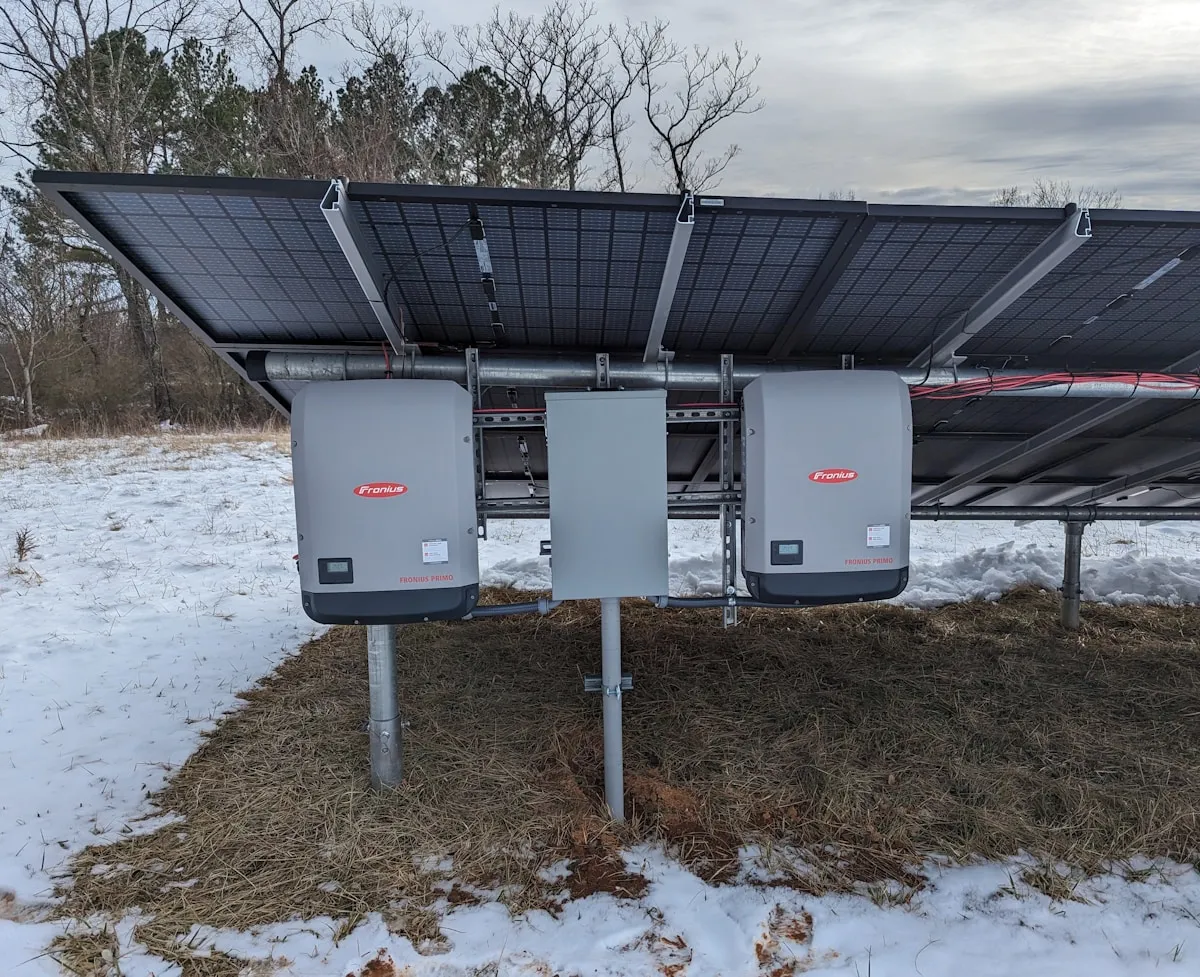
IP65 string inverter mounted on an exterior wall

Infrastructure & Storage Application

Solar Inverter Humidity Protection IP65+

A photovoltaic inverter rated IP65 that shuts down one hour per day due to internal condensation loses 8% of yield over the year — between 60-600 € per inverter annually depending on power class.

The AS-B sticker (residential and microinverters) or AS-C tape (commercial and utility-scale string inverters) protects the internal air of your inverter. Capillary adsorption above 60% RH, spontaneous regeneration. Zero energy, zero maintenance, lifetime aligned with the PV panel itself (25-30 years).

8× usable capacity zone 60-90% RH 0 W consumption — no yield impact String, central, microinverter, DC optimizer REACH — Made in France

Why solar inverters are particularly vulnerable

Extreme thermal cycling on exterior walls

A solar inverter — residential string (3-15 kW), commercial (15-100 kW), or utility-scale (100-300 kW) — is exposed to one of the most severe thermal cycles among industrial IP65 enclosures.

During the day, an inverter housing mounted on a south-facing exterior wall can reach 50-60 °C (122-140 °F) on the surface under combined sun exposure and the thermal output of power modules (IGBT, MPPT). Internal pressure rises, and air escapes through micro-leaks. At nightfall, temperature drops fast — often to 5-10 °C (41-50 °F) in a few hours. Internal pressure collapses, and outdoor air loaded with water vapor flows back through the same micro-leaks.

On a PV fleet exposed 365 days a year for 25 years, this represents over 9,000 cumulative thermal cycles — far beyond the resilience of a calcium chloride pack or a simple pressure equalization vent.

Three cumulative damages O&M operators underestimate

1. Silent yield loss

Internal humidity degrades IGBT module switching performance, increases Joule losses, and triggers protective shutdowns (temperature drift, insulation faults detected by firmware). An inverter that stops 1 hour per day due to condensation = 8% yield loss over the year = up to several hundred euros per inverter annually depending on power class.

2. Arc flash risk on the DC bus

String inverters operate with a DC bus between 600 V and 1,500 V. Condensation on HV traces, DC terminals, or power modules can trigger arc flash — real fire risk, frequently cited in O&M reports on humid or coastal deployments.

3. Rejected warranty claims

SMA, Huawei FusionSolar, Sungrow, Fronius, SolarEdge — all explicitly exclude humidity-related damage from their 5-10 year warranties. When an inverter fails due to internal corrosion, replacement cost (1,800-9,000 USD depending on power class) falls on the O&M operator or owner, not on the manufacturer.

Operational cost

The real cost of condensation on a PV fleet

The cost is not in the factory calcium chloride pack. It's in the combination of lost yield + premature replacement + rejected warranty + fire risk.

8%

yield potentially lost/year

~30 equivalent days/year offline

1,800-9,000 USD

inverter replacement cost

By power class, labor excluded

5-10 years

typical time to humidity failure

vs 25 years nominal PV panel lifetime

100-1,200 USD

O&M intervention cost

PTC Field Service, SightCall

Residential portfolio

On 1,000 installations (3-9 kW each), a 5% humidity failure rate over 10 years represents 90,000-480,000 USD in avoidable replacements — without counting cumulative yield loss during performance drift.

Utility-scale fleet

On 50 string inverters at 100 kW, this means several million USD in PPA revenue + replacement cost that can be protected over the plant's lifetime.

State of the art

Why current solutions don't work

Calcium chloride salts (Rubson, Wisedry, Damprid)

Default solution at SMA, Huawei, Sungrow, and most manufacturers. A 5-10 g pack dropped inside the housing at end of line.

  • Saturated in 6-12 months on a wall-exposed inverter
  • Never replaced once the inverter is installed and commissioned
  • Designed for transport and the first year, not for 25 years

→ AS-B and AS-C solve this pain point: spontaneous regeneration, lifetime aligned with the plant.

Pressure equalization vents (Gore PolyVent)

Found on most modern IP65/IP66 inverters (SMA Sunny Boy, Huawei SUN2000, Fronius Symo). An ePTFE membrane equalizing internal/external pressure.

  • Does not control internal humidity: water vapor passes through the membrane
  • On a 50°C → 5°C thermal cycle, a housing with breather alone condenses as much as a bare housing
  • Significant initial cost on inverter BOM

→ AS-B/AS-C and pressure vents are complementary, not competing.

Forced ventilation by fan + filter

Solution found on some commercial and utility-scale inverters. Continuously refreshes internal air.

  • Consumes 5-30 W (~30% real duty cycle) = direct yield loss
  • Moving component = additional point of failure
  • Filter requires regular maintenance → recurring O&M cost
  • Doesn't stop condensation in fast thermal cycling

→ Active solution with recurring cost; AS-C achieves the same result passively.

Conformal coating on PCB

Acrylic or polyurethane varnish on the control board. Protects low-voltage traces.

  • Protects the control board, not the HV power modules or the DC bus
  • Doesn't address terminals, connectors, disconnectors
  • Significant cost on inverter assembly line

→ Coating and AS-B/AS-C are complementary: coating for components, AS-B/AS-C for internal air.

Format selection

Which So Sponge format for your inverter type

This is the structural question for PV: AS-B (sticker) or AS-C (tape)? The answer depends on internal volume of the housing and power class.

Inverter typePowerInternal volumeRecommended format
Microinverter Enphase IQ7/IQ8250-650 W0.3-0.5 LAS-B/XS or /S
Residential string SMA Sunny Boy, Huawei SUN2000 residential, Fronius Primo3-15 kW5-20 LAS-B/M or /L
Commercial string Sungrow SG, SMA Tripower, Huawei SUN2000 commercial15-100 kW20-80 LAS-C tape (sized surface)
Utility-scale string Sungrow SG250HX, Huawei SUN2000-330KTL100-330 kW80-300 LAS-C tape (large surface)
Central inverter Power Electronics, Ingeteam, ABB FIMER, Sungrow SG3000HV1-5 MW1-10 m³AS-C multiple meters
DC optimizer SolarEdge HD-Wave, Tigo TS4350-700 W0.2-0.4 LAS-B/XS

Uncertain volume or hybrid case? The AS-B and AS-C calculators on the product pages handle all volumes — enter internal volume, expected thermal cycle, and you get the required SRD surface and optimal format.

Integration

How to integrate in practice

Residential string inverter (3-15 kW)

The AS-B/M or AS-B/L sticker bonds to the inner wall of the access door or top cover, on the power-component side. No drilling, no electrical modification. Pre-applied adhesive, placement in less than 30 seconds per inverter on the assembly line.

If the inverter already has a Gore Vent breather: combine both (pressure + humidity). If no breather: AS-B/L alone is sufficient in most cases under temperate climate.

Commercial / utility-scale string inverter (15-330 kW)

The AS-C tape (2-5 cm width, sized length depending on volume) bonds to the inner wall of the electronics compartment, away from hot components (heatsinks, IGBT modules) and forced-air flow paths if present. Sized surface is calculated by the AS-C calculator.

MW central inverter

Several meters of AS-C tape are integrated on the inner walls of the container or central cabinet, ideally distributed for homogeneous capture. Free technical sizing study with So Sponge for initial deployment.

Animation

Silica gel vs SRD: adsorption isotherms under humidity cycling

Observe how the compared materials behave over a single cycle, then across time.

0.9 0.8 0.7 0.6 0.5 0.4 0.3 0.2 0.1 0 0 20 40 60 80 100 Relative humidity (%) Water adsorbed (mL/g) Cap 0.4 mL/g Silica accumulated: 0.00 mL/g SRD current load: 0.00 mL/g Silica gel (isotherm) SRD (isotherm)
Scrub timeline slow-mo
↤ cycle 1 slow-mo fast cycles →

Cycle

1

Current RH

50%

Silica gel saturation 0%

Cap 0.4 mL/g

⚠ REPLACE
SRD saturation 5%

Cap 0.87 mL/g

0 cycles complete

Lab test & B2B validations

IP66 climate chamber validation

30 °C → 0 °C (86 °F → 32 °F) ramp over 1 h 20. Three identical IP66 housings:

ConfigurationResult
Bare housing (control)Visible condensation
Housing + pressure vent only (Gore Vent)Visible condensation (matches control)
Housing + AS-B stickerZero internal condensation

Test conditions correspond exactly to a wall-mounted inverter thermal cycle (daytime heating + nighttime cooling). No extrapolation needed.

Active B2B validation programs

Weather instrumentation

Leading Nordic manufacturer, T°/RH instruments exposed to strong gradients

Industrial vision & imaging

German manufacturer, outdoor optical sensors

Aerospace / Defense

Leading European group, UL qualification ongoing on severely cycled housings

Medical X-ray imaging — Thales

Favorable internal validation

FAQ

Solar inverters and anti-condensation

My SMA / Huawei / Sungrow IP65 inverter triggers unexpected shutdowns in winter — can condensation be the cause?

Yes. Internal condensation on power modules or HV traces can trigger insulation faults detected by the firmware (PV Iso Fault, Bus Voltage Fault), causing protective shutdowns. On a wall-exposed inverter cycling 50 °C → 5 °C day/night, this phenomenon is recurrent in shoulder seasons and winter. The AS-B sticker (residential) or AS-C tape (commercial / utility-scale) keeps internal humidity below 60% and eliminates this source of shutdowns.

AS-B sticker or AS-C tape: how to choose for my inverter?

Mainly an internal volume question:

  • Residential inverter (3-15 kW, volume 5-20 L) → AS-B/M or AS-B/L
  • Commercial inverter (15-100 kW, volume 20-80 L) → AS-C tape
  • Utility-scale (100+ kW, volume 80+ L) → AS-C tape sized
  • Microinverter (Enphase) → AS-B/XS or /S
Does the AS-B sticker / AS-C tape replace an existing Gore Vent?

No — they're complementary. Gore Vent equalizes internal/external pressure to prevent mechanical stress on gaskets in thermal cycling, but it does not stop condensation. SRD adsorbs internal water vapor. On an outdoor inverter cycling 50 °C → 5 °C, both solutions are used together: vent for pressure, AS-B/AS-C for humidity.

Compatibility with HV components (DC bus 600-1,500 V)? Dielectric risk?

None. The SRD material is a chemically inert and electrically neutral mesoporous aluminum oxide. It creates no conductive bridge, doesn't alter the dielectric properties of surrounding insulation materials, and cannot facilitate arc flash. On the contrary, by eliminating condensation on DC terminals and IGBT modules, SRD reduces humidity-related arc flash risk.

Compatibility with internal fans of my inverter?

Yes. The AS-B sticker and AS-C tape bond to static internal walls, away from forced airflow paths. They don't disturb internal ventilation. By reducing ambient humidity, they actually extend fan bearing life (corrosion + humidity being the leading cause of industrial fan failures).

My inverter has a 10-year warranty — does adding AS-B void the warranty?

To be checked case-by-case in manufacturer terms and conditions. In most cases, adding a passive consumable without electrical or mechanical modification does not void the product warranty. Manufacturers generally exclude damage caused by external humidity from their warranty — the AS-B/AS-C solution protects the warranty rather than jeopardizing it. A pre-notification letter to the manufacturer is recommended for significant deployments.

What about my residential portfolio already installed for 5 years — can I retrofit?

Yes technically, the AS-B sticker can be applied to an installed inverter during a maintenance or cleaning intervention. Retrofit prevents further degradation and stabilizes future performance, but doesn't repair existing corrosion. For an O&M with annual visits already scheduled, retrofit is essentially free in labor.

What lifetime for the sticker / tape on a 25-year exposed inverter?

Unlimited under normal operating conditions of a PV inverter (-20 to +70 °C, REACH, RoHS). The SRD material is mineral and doesn't degrade over time like a disposable consumable. Over the typical 25-year lifetime of a PV plant, no replacement is required.

MOQ and lead time for an inverter manufacturer?

Standard MOQ: 5,000 units for AS-B/XS, 2,500 units for AS-B/S/M/L, sized surface for AS-C. Lead time 6-8 weeks after order confirmation. Express on request. Tiered pricing by volume.

Compliance with PV standards (IEC 61730, IEC 62116, IEC 62109)?

These standards cover photovoltaic safety requirements (panels, inverters, cabling) — not anti-condensation accessory composition. No incompatibility — the SRD material is passive, inert, and doesn't affect inverter normative performance. REACH and RoHS confirmed on request.
Evaluation

Request free samples

Test the AS-B sticker or AS-C tape on your own inverters. So Sponge provides free samples for B2B technical evaluation and offers a free sizing study for utility-scale deployments.

Related resources

Technical resources