Calcium chloride: the forgotten bulk desiccant
Where silica gel protects small IP65 enclosures, another consumable takes over on large volumes: industrial electrical cabinets, maritime containers, storage workshops, technical rooms. That consumable is calcium chloride — sold in 1 to 2 kg tubs or buckets, with strong desiccant capacity but underestimated logistics.
This article examines this specific use case: volumes, frequency, waste generated, regulatory specifics, and substitution potential.
An industrial-grade hygroscopic salt
Calcium chloride (CaCl₂) is a salt that absorbs moisture until dissolution — it progressively transitions from solid to liquid brine by the end of its cycle. This deliquescent behaviour is well characterised: above a deliquescence humidity of roughly 29 to 32% RH at 25°C, the salt captures water vapour and dissolves into brine ([CaCl₂ and relative humidity, RSC Advances, 2021](https://pubs.rsc.org/en/content/articlelanding/2021/ra/d0ra08943e); deliquescence/efflorescence database). That very property makes it an excellent desiccant for large confined volumes: electrical cabinets, maritime containers, storage workshops, non-climatised technical rooms.
The classic industrial format: a plastic tub of 1 to 2 kg, with a lower compartment collecting the brine. Modest unit cost (a few euros), fast efficacy.
Typical specs and replacement cycle
- Weight: 1 to 2 kg per tub
- Volume treated: 20 to 50 m³ depending on ambient humidity
- Lifespan: around 3 months in temperate humid climate, 6 to 8 weeks in tropical climate
- Waste per cycle: the whole tub (plastic + salt partly turned into brine)
- Reverse logistics: the brine is corrosive (contains chloride ions) and must be disposed of with care
For typical industrial use — an electrical cabinet or storage container of roughly 33 m³ —, one or two 2 kg tubs are installed per season. Over 5 years, this represents ~40 kg of consumable used, with as much to dispose of, including the associated brine.
A specific waste: chlorinated brine
Unlike silica gel sachets that become dry waste, calcium chloride tubs end their lives in liquid form: a saline solution that can contain up to several litres of brine per cycle.
This brine raises three concrete issues:
- Corrosivity — chloride ions are aggressive on steel and ferrous metals (a recognised atmospheric-corrosivity factor classified by ISO 9223). Spilled brine inside an electrical cabinet can damage busbars, panels and metallic components.
- Volume — unlike sachets, it is not compactable. Reverse logistics carries useless weight and volume.
- Stream — chlorinated brine has no established recycling route. It ends up in general industrial waste after neutralisation, sometimes in hazardous industrial waste depending on its composition and additive concentration.
The hidden cost: not on the BOM
Like silica gel, the calcium chloride tub shares three characteristics that make it a blind spot:
- Off-BOM — it is purchased in maintenance, not at the time of equipment manufacturing. It does not appear on the host equipment’s datasheet.
- Off consolidated Scope 3 — GHG Protocol categories Purchased Goods (1), Waste (5) and End-of-life (12) are involved, but the flow is diffuse and rarely aggregated.
- Off product lifespan — the equipment is advertised for 15-20 years but requires quarterly intervention on its desiccant. Product / brand durability alignment breaks down.
The real cost: field intervention
On distributed fleets — street cabinets, maritime containers, telecom cabinets, remote technical rooms — the cost of the consumable is negligible compared to the intervention:
- Technician travel: tens to hundreds of euros per visit
- On-site or rolling inventory management
- Cabinet opening / closing, lockout/tagout procedures if live
- Waste handling: collection, transport, treatment
Replacing a 2 kg tub every 3 months on 100 installations represents 400 interventions/year and 400 kg/year of consumable to handle downstream.
Regulatory context
Recent evolutions make this flow visible:
- ESPR — Regulation (EU) 2024/1781 — requires industrial equipment to demonstrate coherent durability. A product that depends on a quarterly consumable raises questions on its actual service life.
- CSRD — Directive (EU) 2022/2464 / ESRS E5 — mandates reporting of resource use, waste generated and circular strategy. Recurring operating consumables become material.
- Waste Framework Directive 2008/98/EC — chlorinated brines are classified as industrial waste, with treatment streams falling under producer responsibility (EPR depending on country).
Most concerned segments
The segments that combine large protected volumes + distributed fleets + regulatory exposure are the most mature for substitution:
- Industrial electrical cabinets and street cabinets — 5G telecom deployments, smart grid, energy distribution. Volumes of 0.5 to 2 m³ per cabinet, sometimes up to 10 m³ for cabinets.
- Maritime containers — freight containers, long-term storage containers, offices or workshops in converted containers. Volumes of 33 m³ (20 ft) to 76 m³ (40 ft).
- Technical rooms and non-climatised workshops — spare parts storage rooms, cold storage warehouses.
- Military and defence equipment — prolonged storage, demanding outdoor environments, consumable traceability.
The alternative: a permanent material instead of a recurring consumable
The AS-C tape is based on the same self-regenerating material as the AS-B sticker — mesoporous SRD alumina — but sized for large volumes: an 8 cm wide ribbon pre-cut every 25 cm (200 cm² stickers), delivered as adhesive rolls to stick inside the installation.
For a container or cabinet of ~33 m³, an AS-C installation represents ~4 m² of active surface and ~800 g of alumina material, installed once. Lifespan aligned with the installation’s (5+ years), without replacement.
The arithmetic for a typical 33 m³ installation over 5 years:
| Approach | Annual consumable | 5-yr waste | 5-yr visits |
|---|---|---|---|
| Calcium chloride tub | ~8 kg (4 cycles × 2 kg) | ~40 kg + brine | 20 visits |
| AS-C tape | 0 | 0 kg | 0 visits after installation |
Across 100 installations equipped, the differential represents ~4 tonnes of chlorinated salt avoided over 5 years and the elimination of 2,000 maintenance visits dedicated to the desiccant.
Conclusion
Calcium chloride is effective, cheap per unit and easy to deploy. But at the scale of an industrial fleet, it combines three structural drawbacks: a recurring consumable, demanding reverse logistics (corrosive brine), and quarterly maintenance incompatible with the advertised lifespan of host equipment.
ESPR, CSRD and waste regulations are today pushing to make this flow visible and reduce it. For an industrial player deploying street cabinets, storage containers or distributed workshops, substitution by a passive permanent desiccant is the most direct lever to step out of the loop — and align real installation durability with the advertised product durability.
To assess the impact on your own fleet, use our AS-C calculator or browse our sustainability page for an overview of the approach. For the equivalent case on small enclosures, see Silica gel: the blind spot of industrial eco-design.
Sources
- CaCl₂ deliquescence: RSC Advances, 2021; deliquescence/efflorescence database (deliquescence humidity ~29-32% RH at 25°C).
- ISO 9223 — Corrosion of metals and alloys — Corrosivity of atmospheres: chlorides as a major steel-corrosion factor.
- Waste Framework Directive 2008/98/EC · ESPR (EU) 2024/1781 · CSRD (EU) 2022/2464 (EUR-Lex).
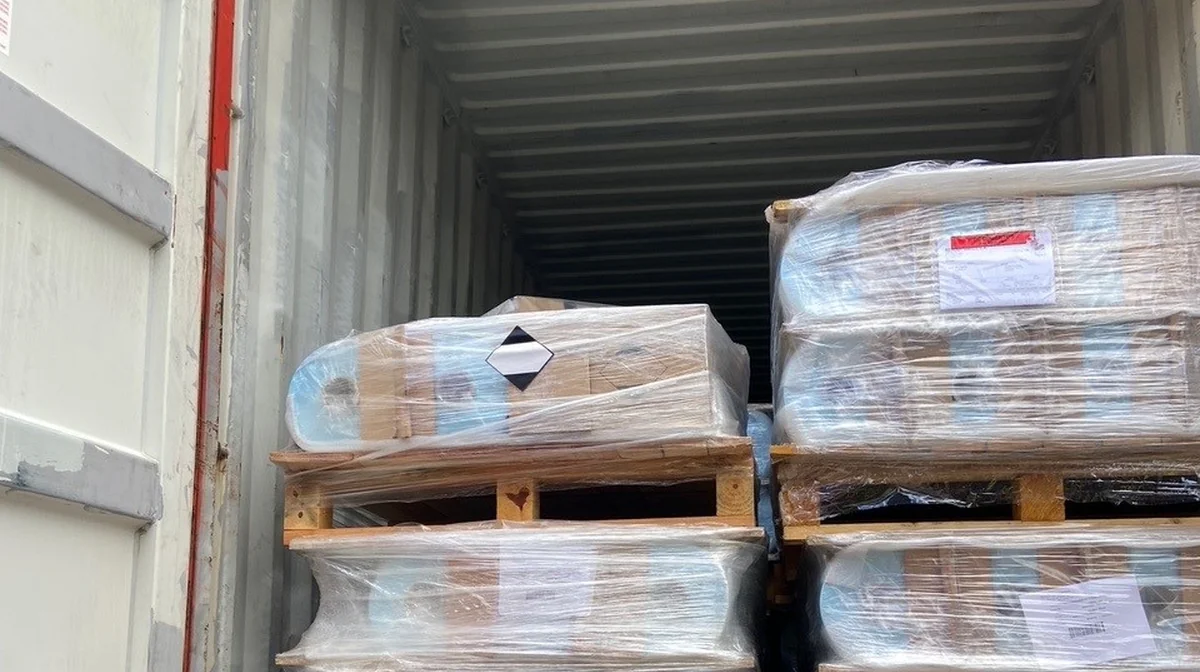
Image credit: Interior of an intermodal container, via Wikimedia Commons.