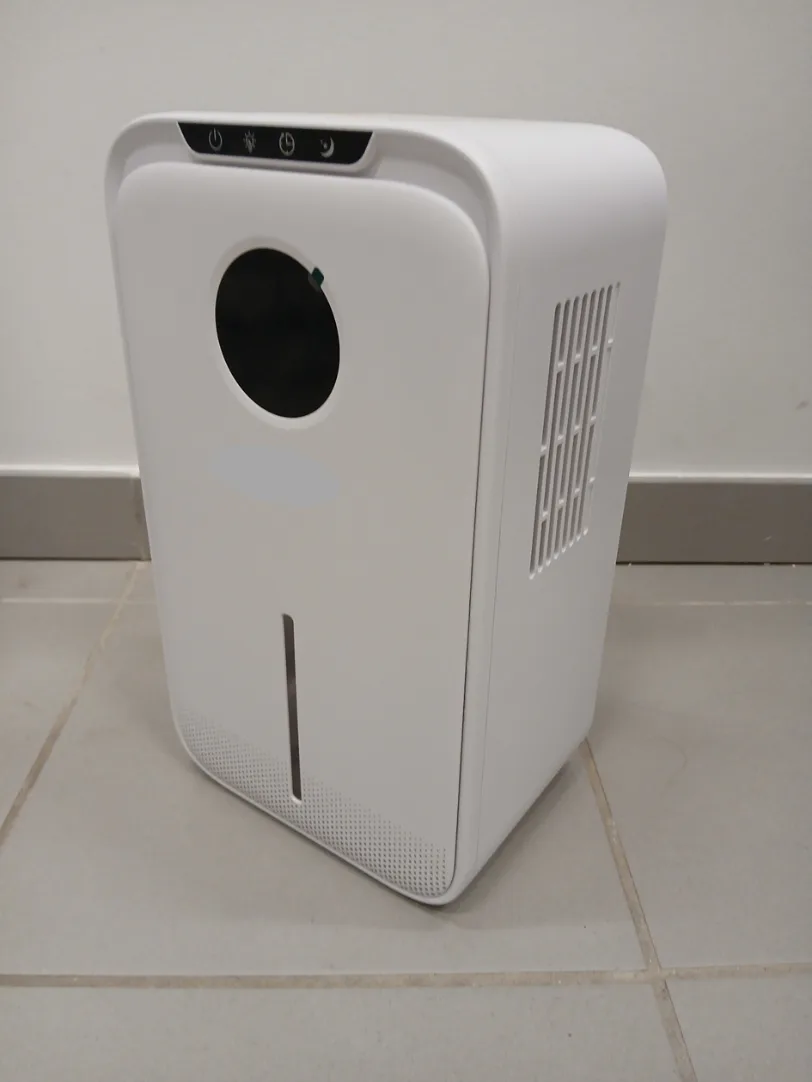
Electric Dehumidifier: How Does It Work?
What is a dehumidifier?
A dehumidifier is an electrical appliance designed to reduce humidity in the air by condensing the water vapor it contains. It is commonly used to treat humidity in a room, a cellar, a garage, or enclosed spaces when ambient humidity is too high.
What is the basic operating principle of a dehumidifier?
The operation of a dehumidifier relies on a simple principle: cooling the air to condense the water vapor it contains.
To achieve this, the device brings humid air into contact with a cold coil, just like in a domestic refrigerator. This system relies on a compression and expansion refrigeration cycle of a refrigerant fluid.
How does a dehumidifier actually work?
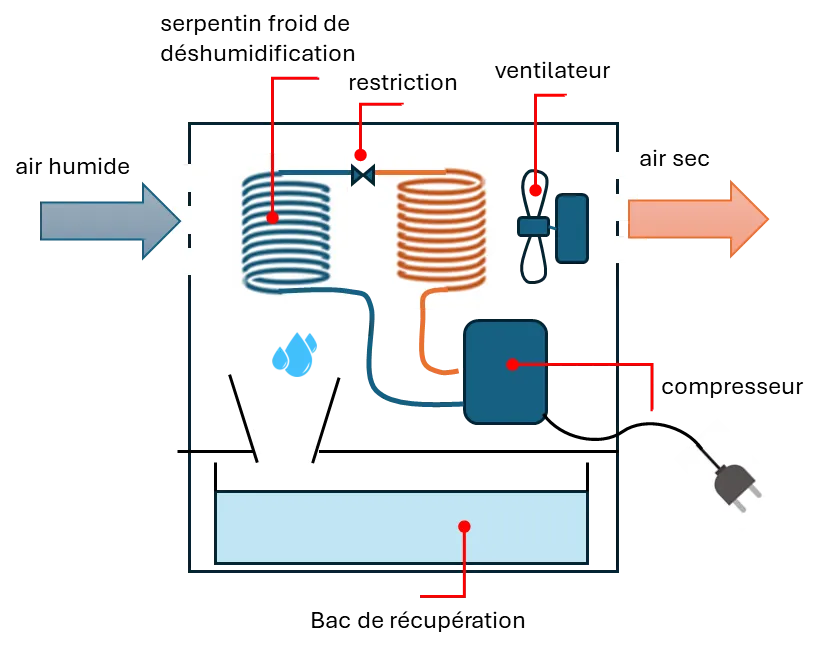
The operation unfolds in several successive stages:
-
Air intake — A fan draws room air into the unit.
-
Condensation of humidity — The humid air contacts the cold coil. Water vapor then condenses into droplets.
-
Water collection — Condensed water drains into a recovery tray (or toward an evacuation).
-
Reheating and air discharge — The dried air passes over the hot coil before being returned to the room.
The relative humidity level gradually decreases.
What are the advantages of dehumidifiers?
Condensation dehumidifiers offer several benefits:
- Proven and robust technology
- High efficiency in temperate or warm environments
- Capacity to process large air volumes
- Solution adapted for highly humid rooms
They are often used to combat:
- Ambient humidity
- Condensation
- Degradation linked to excess humidity
What are the limitations of a dehumidifier?
Energy consumption and noise
The compressor and fan operate continuously:
- Significant energy consumption
- Sometimes high noise levels, particularly in living spaces
Size
For treating large volumes, the device can be:
- Bulky
- Not very discreet
- Difficult to move
Reduced efficiency at low temperatures
To condense effectively, the cold coil temperature must be significantly lower than the room temperature. In cool or cold rooms, the dehumidifier becomes less effective, or even ineffective.
This is a structural limitation linked to its operating principle.
Dehumidifier or passive solution: how to choose?
The dehumidifier relies on active, mechanical, and electrical operation. It is suited for heated rooms and large volumes.
However, in:
- Enclosed spaces
- Small volumes
- Cold or unheated areas
Passive solutions may be more suitable.
Air Sponge: an electricity-free alternative
Solutions like Air Sponge work through water vapor adsorption, without a compressor or fan.
Unlike an electric dehumidifier:
- No energy consumption
- No noise
- No loss of efficiency in cold environments
- Continuous action on ambient humidity
They are particularly suited for boxes, closets, housings, containers, or areas with localized condensation.
Conclusion
The operation of a dehumidifier relies on an effective thermodynamic principle for condensing humidity from the air. It is a high-performing solution under specific conditions, but also has limitations related to temperature, noise, and energy consumption.
The choice between an electric dehumidifier and a passive solution depends on:
- The volume to be treated
- The ambient temperature
- Energy and acoustic constraints