Relative vs absolute humidity: the difference
What is relative humidity?
Relative humidity (RH) is the percentage ratio between the pressure of water vapor in the air and the pressure of saturated vapor at a given temperature.
In other words, it is the humidity level present in the air compared to the maximum quantity that the air can contain before condensation. To go deeper into the math, see our guide to the relative humidity formula.
This measurement varies with room temperature: the warmer the air, the more water vapor it can contain without reaching saturation. This is why we speak of a relative rate: at 20°C, 50% relative humidity does not represent the same quantity of water as 50% at 30°C. This temperature dependence comes from the saturation vapor pressure, which rises sharply with temperature (Magnus-Tetens, Oregon State University).
Example: At 25°C, 60% relative humidity means the air contains 60% of the water vapor it could potentially retain before saturation.
Why measure relative humidity?
It is the most commonly used value in building, logistics, and indoor humidity control because it provides practical, directly usable information. It helps:
- Prevent condensation problems (ceiling humidity, wall condensation)
- Maintain good thermal comfort
- Preserve humidity-sensitive materials (wood, cardboard, textiles)
What is absolute humidity?
Absolute humidity (AH) corresponds to the mass of water vapor contained in a given volume of air, expressed in g/m3. Unlike relative humidity, it does not depend on temperature.
For example, 10 g/m3 means each cubic meter of air contains 10 grams of water vapor, regardless of thermal conditions.
Absolute humidity is less commonly used daily but proves useful for:
- Physics or climatic calculations
- Technical analyses (industry or laboratories)
- Dew point measurements and dehumidifier design
Relative and absolute humidity: key differences
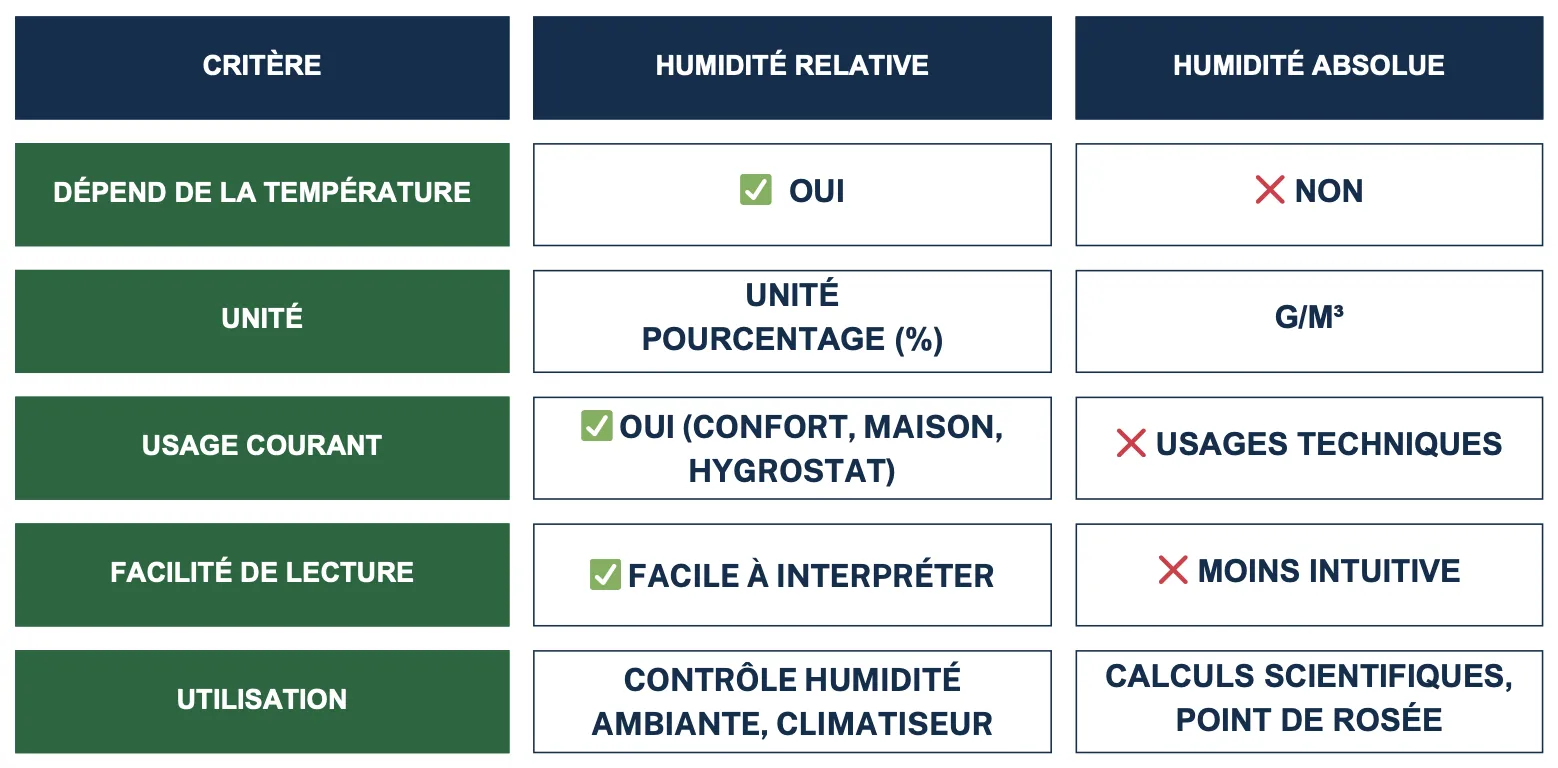
| Aspect | Relative Humidity | Absolute Humidity |
|---|---|---|
| Definition | Percentage ratio of water vapor to saturation | Mass of water vapor per volume |
| Unit | Percentage (%) | g/m3 |
| Temperature dependence | Varies with temperature | Independent of temperature |
| Common use | Daily applications, building control | Technical/scientific purposes |
How do you measure relative and absolute humidity?
Measuring tools
- Humidity sensor or professional humidity tester
- Hygrometer (shows relative humidity)
- Wall humidity meter (useful for detecting humidity in walls)
- Connected sensors can calculate both values from room temperature and pressure
In summary
- Relative humidity varies with temperature and is used in everyday applications
- Absolute humidity remains constant for a given air volume and serves technical purposes
Both measurements complement each other for effective humidity control in a space.
So Sponge solution
Putting adsorption physics to work for humidity control
So Sponge's mesoporous SRD alumina captures water vapor through capillary condensation above a humidity threshold — exactly the physics described above. The result: a sticker or ribbon that regulates the internal humidity of an IP enclosure without energy, without consumables, and that regenerates on its own.
Sources
- M. G. Lawrence, The Relationship between Relative Humidity and the Dewpoint Temperature in Moist Air, BAMS, 2005 — relative humidity, saturation and temperature.
- Saturation vapor pressure and dew point (Magnus-Tetens), Oregon State University.