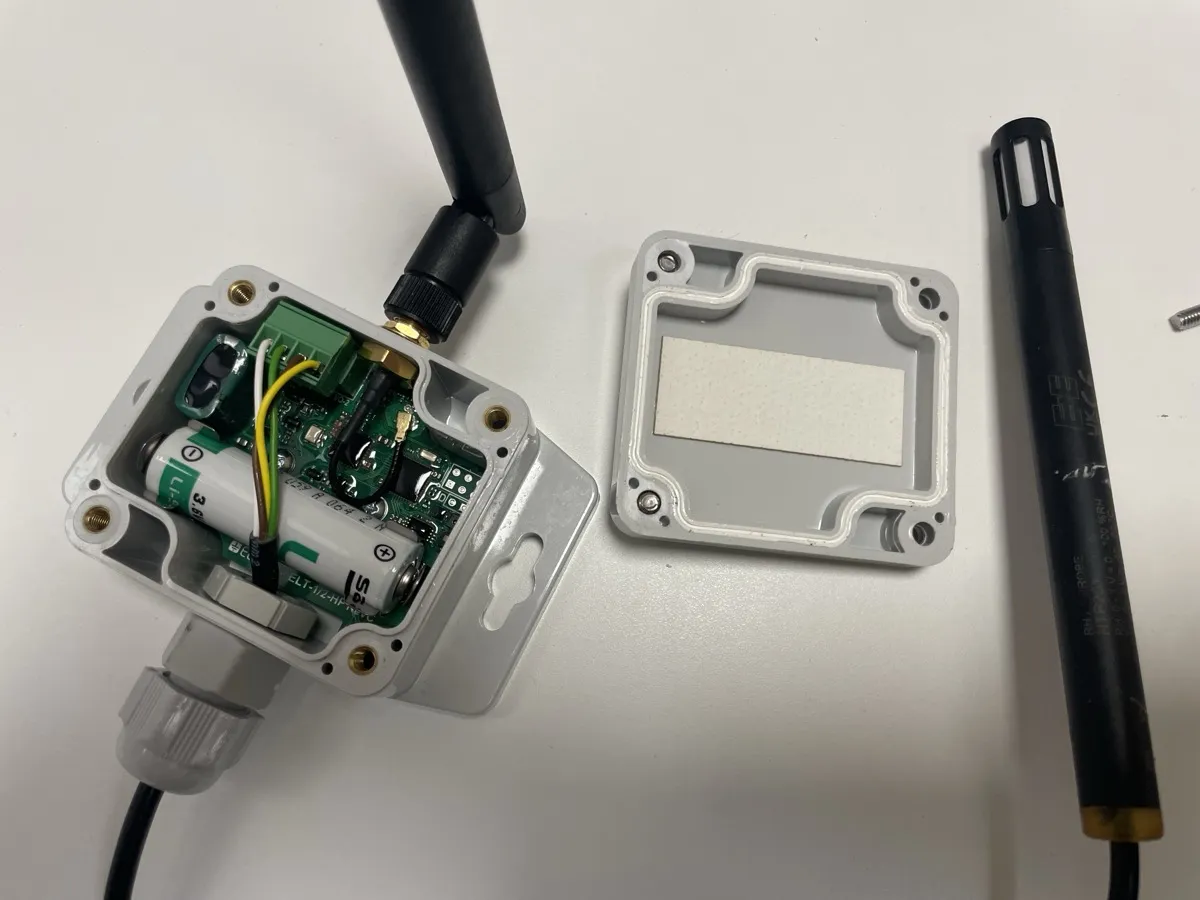
Gore Vent, breather vent or desiccant breather: what works?
The short answer
Gore Vent, breather vent or desiccant breather: which one stops condensation in an enclosure? None of the three on its own. A Gore Vent is the best-known brand of breather vent, also called a pressure compensating plug: a microporous membrane that lets air and water vapour through and blocks liquid water, so that the pressure inside a sealed box follows the outside. A desiccant breather is a different object, a cartridge of silica gel screwed on the vent port of a hydraulic reservoir or a gearbox, which dries the air the tank draws in. Neither captures the water vapour already inside an electronic enclosure, and that vapour is what condenses on a cold lens or board at dawn. What stops the fog is a desiccant inside the box; what keeps the seals healthy is the vent. They go together.
This page compares the four devices a buyer meets when searching for a Gore Vent alternative: the membrane vent, the desiccant breather, the silica gel sachet and the SRD sticker. So Sponge manufactures the last one; method and sources are at the end.
See the validated use cases · Request a free sample kit
Gore Vent, desiccant breather, silica gel, SRD sticker: the table
| Criterion | Breather vent, membrane (Gore Vent type) | Desiccant breather (tank and gearbox) | Silica gel sachet | SRD sticker (AS-B) |
|---|---|---|---|---|
| What it does | Equalises pressure, blocks liquid water and dust | Dries the air drawn into a tank through its vent port | Adsorbs vapour inside the box until full | Adsorbs vapour inside the box, releases it by day, cycles indefinitely |
| Regulates internal pressure | Yes | Yes, through the port | No | No |
| Captures vapour already inside | No, the membrane passes vapour by design | No, it treats incoming air only | Yes, until saturated | Yes, and releases it in the warm phase |
| Stops condensation in a sealed electronics enclosure | No | No, wrong device: needs a vent port and a large breathing volume | Yes, while it has capacity | Yes |
| Needs a hole in the wall | Yes, M12 thread or adhesive over a hole | Yes, a threaded port | No | No |
| Consumable | Membrane, replaced when clogged | Silica gel cartridge, replaced when the indicator turns | Sachet, replaced when full | None |
| Maintenance | Inspection | Cartridge change | Replacement or oven drying | None |
| Power | 0 W | 0 W | 0 W | 0 W |
| Typical use | Outdoor electronics, lighting, automotive, IP64 to IP68 | Hydraulic reservoirs, gearboxes, storage tanks, transformers | Packaging, small boxes | Sealed electronic enclosures 0.5 to 20 L |
| Unit cost (excl. VAT) | A few euros | Tens of euros per cartridge | Under 1 € | 1.75 € per 50 × 20 mm sticker on a roll of 100 |
Data as of 28 September 2026. Vent function as stated by membrane manufacturers (GORE, Porex); desiccant breather described as a product type, not one brand; sources at the end.
What a breather vent is, and how it works
A breather vent, or pressure compensating plug, is a connector fixed into the wall of a watertight housing, threaded (M12 is the common size) or adhesive over a drilled hole. It carries a microporous membrane, usually expanded PTFE, that lets air and water vapour pass and blocks liquid water: rain, spray, wash-down. GORE, whose Gore Vent range gave the category its everyday name, describes its protective vents as equalising pressure and preventing liquid ingress; Porex describes the same function for its hydrophobic PTFE membranes.
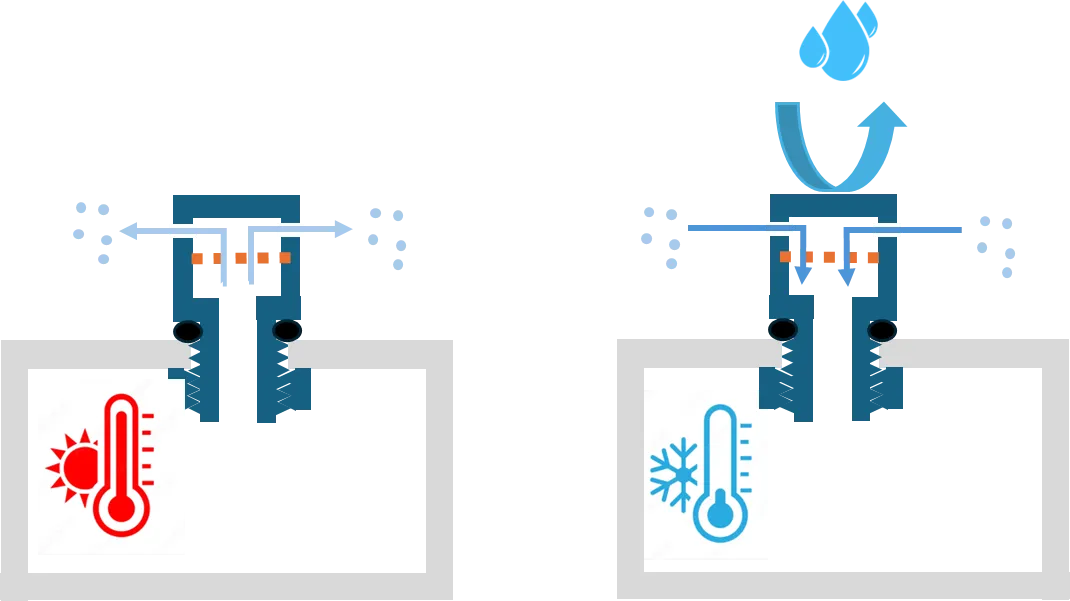
The mechanism is simple. When the enclosure warms, the air inside expands and escapes through the membrane. When it cools, the pressure drops and outside air comes back in through the same membrane. Without a vent, that pressure cycle works the gaskets every day, ages them, and eventually pulls liquid water past a tired seal. The vent’s job is therefore mechanical: it protects the seals, and through them the IP rating. On outdoor boxes with large day/night swings, at altitude, or under wash-down, it is the right part to fit.
Why a Gore Vent does not stop condensation
Because the membrane is permeable to water vapour by design. The outside air that comes in on every cool-down carries its humidity with it, and the vent does nothing to it. Over a season the air inside catches up with the outside humidity, and when the temperature drops fast at night the vapour reaches its dew point on the first cold surface: a lens, a board, the lid. The vent has done its job, the seals are fine, and the electronics are wet.
Membrane manufacturers say so themselves: the function is pressure equalisation, and the membrane passes air and water vapour while blocking liquid water. GORE’s adhesive vents are described as reducing condensation, which is true in one sense, they stop pressure-driven liquid ingress and reduce the vacuum that pulls humid air in, but they do not dehumidify the volume. The water vapour that is inside stays inside.
We measured it. Three identical IP66 enclosures went through the same cooling ramp in a climate chamber, 30 °C to 0 °C in 1 h 20: the empty box fogged, the box fitted with a breather vent fogged just the same, and the box fitted with the SRD sticker stayed clear. Protocol and photos are in Gore-Tex vent vs SRD AS-B, climate chamber test.
What a desiccant breather is, and why it is not for a sealed enclosure
A desiccant breather is the device that comes up when you search for a “breather” with drying in mind. It is a canister of silica gel, often with a colour indicator, screwed on the vent port of a hydraulic reservoir, a gearbox, a storage tank or a transformer conservator. Those systems breathe large volumes: a reservoir takes in litres of air each time a cylinder extends, a tank each time it is drained. The breather dries that incoming air before it reaches the oil, and sometimes filters it. When the silica gel is saturated the indicator turns and the cartridge is replaced.
It is the right device for a tank. It is the wrong device for an electronic enclosure, for three reasons.
- It needs a port and a flow. A desiccant breather works on air that passes through it. A sealed IP65 box breathes through its seals and glands, in millilitres, not through a port in litres. There is nothing for the breather to treat.
- It treats incoming air only. The vapour that is already inside the box, and the vapour that comes in through the seals, never pass through the cartridge.
- It is a consumable on a maintenance schedule. Cartridges are sized and changed on plant maintenance rounds. A field enclosure has no maintenance round.
The idea behind it, dry the air that comes in, is sound. Applied to a small sealed enclosure it becomes: dry the air that is in. That is what a desiccant inside the box does.
Drying the air inside: sachet or sticker
Two desiccants can sit inside the enclosure.
A silica gel sachet adsorbs vapour until it is full, then stops. In a box that breathes with the weather, that point comes in weeks to months, and on a deployed fleet nobody comes back to change a sachet. We covered lifetimes and oven recharging in Reusable desiccant vs rechargeable vs disposable.
The SRD sticker is a self-regenerating desiccant, a mesoporous alumina bonded into a self-adhesive 50 × 20 mm strip. It adsorbs water above roughly 60 % relative humidity, with six times the capacity of silica gel above 60% RH, and releases it during the warm phase of the daily cycle, inside the enclosure, at ambient temperature. The cycle repeats indefinitely: nothing to replace, nothing to power, no hole in the wall, −20 to +70 °C. One sticker per litre, up to 20 L. The material is described on the SRD material page, and against other desiccants in Activated alumina vs silica gel.
Vent plus sticker: why they go together
The two devices act on different terms of the same equation. Condensation needs a temperature drop and enough vapour. The vent does not change either; it keeps the pressure cycle from destroying the seals, which is what keeps liquid water out for the life of the box. The sticker captures the vapour during the cold phase and holds it until the enclosure warms up, which is what keeps the dew point from being reached inside.
So the recommendation for an outdoor IP65 to IP68 enclosure with strong thermal cycling is not “Gore Vent or desiccant” but both: keep the vent, add the sticker. The sticker needs no port and does not interfere with the vent. Where a vent is not fitted, because the box is small, the swings are moderate or the wall cannot be drilled, the sticker alone handles the humidity and the seals live with the pressure cycle as they did before.
- Fit a breather vent when the enclosure sees large pressure swings: outdoor, altitude, wash-down, large volumes.
- Add a desiccant inside when the electronics must stay dry: optics, boards, connectors. Between sachet and sticker, the choice is the number of site visits you accept.
- Leave the desiccant breather to the tanks. It solves a different problem.
- Above 20 L, cabinets, shelters and containers, the sticker format is too small; the AS-C ribbon is the same material as a pre-cut ribbon (25 × 8 cm stickers, 200 cm²).
Which combination for which enclosure
| Your situation | Vent alone | Desiccant alone | Both |
|---|---|---|---|
| Potted or coated electronics, no optics, no exposed contacts | ✅ often enough | — | — |
| Small sealed enclosure (up to ~20 L) with a lens, display or sensor | — | ✅ | ✅ if pressure cycling is strong |
| Outdoor enclosure with strong day/night swings and a long service life | — | — | ✅ |
| Batteries or components that outgas | ✅ required | — | ✅ add the desiccant for optics and boards |
| Enclosure opened often for maintenance | — | ✅ size it up | ✅ |
| Large cabinet (above ~20 L) | — | ✅ AS-C ribbon | ✅ |
The vent is about the mechanics of the enclosure: seals, pressure, gases. The desiccant is about the air around your lens and your boards. If condensation would cause a failure, a drift or a fogged image, the vent alone is not enough.
Does a vent change how you size the desiccant?
Yes. A vent increases air exchange with the outside, so over a day more vapour enters and leaves than in a fully sealed box.
- With a silica gel sachet, this is bad news. It fills up faster, and once it is full it starts giving water back when the enclosure heats up in the sun. That water condenses again on the first cold surface: the sachet delays the fog rather than preventing it. The mechanism is explained in Does a desiccant increase moisture ingress?.
- With a self-regenerating sticker, the extra vapour is captured during the humid phases and released during the dry ones. It does not accumulate, but the surface must be large enough to absorb each peak.
Start at about one 10 cm² sticker per litre of internal volume, up to 20 L, and add margin when the enclosure is vented, opened often or exposed to very humid nights. The behaviour in an enclosure that exchanges air with the outside is documented: in IP54 EV chargers, which breathe far more than a vented IP67 box, the ribbon cut the condensation time by 2.6 over 85 winter days (field test).
Vent or sticker: compare the cost of a failure, not the unit price
A vent costs a few euros, a sticker 1.75 €. Comparing the two prices makes no sense, because they do not do the same job: keeping the vent and skipping the sticker saves 1.75 € and leaves the condensation in place.
The useful comparison is the cost of one field failure caused by condensation: a technician’s visit, a replaced board or camera, the downtime, and the customer’s trust. On a deployed fleet, preventing a small share of these failures pays for the stickers of the whole fleet. Put in your own figures (failure cost, failure rate, fleet size) in the return-on-investment calculator.
You can also check the result on your own enclosure before deciding: How to test an anti-condensation solution without a climate chamber.
What the field says
On an autonomous agricultural robot, a silica gel sachet and a pressure compensator were already fitted and were not enough; the sticker captured the residual moisture. On a 0.6-litre IP67 camera enclosure, 48 hours in a climate chamber at −1 to +3 °C and 90 to 94 % RH left glass and optics dry with a single 10 cm² strip. Both cases, with protocol and results, are on the validated use cases page; no customer is named.
How we compared, and our position
So Sponge manufactures the AS-B sticker and the AS-C ribbon compared here. The vent description is the manufacturers’ own: GORE for its protective vents, Porex for hydrophobic PTFE membranes, both stating pressure equalisation, permeability to air and vapour, and a barrier to liquid water. The desiccant breather column describes the product type as sold for reservoirs and gearboxes, without naming a brand; costs are orders of magnitude, not quotations. The climate chamber test is ours, documented in the linked article. Where a figure is generic to a product type, the table says so. This page will be revised when the manufacturers update their ranges.
Related comparisons: Gore-Tex vent vs SRD AS-B, climate chamber test · Test it without a climate chamber · Enclosure heater vs desiccant · Reusable desiccant vs rechargeable vs disposable · All anti-condensation solutions compared
Order AS-B online, from €100 excl. VAT
Sources
- W. L. Gore & Associates, Protective Vents: membrane permeable to air and vapour, barrier to liquid water, pressure equalisation function
- Porex, Hydrophobic PTFE membranes: gas and vapour transport through micropores, liquid water barrier
- So Sponge, climate chamber test on three IP66 enclosures and validated use cases