Salt-air corrosion in coastal electrical enclosures
Key takeaways — 4 points to remember
- 🌊 Coastal site = ISO 9223 C5/CX : steel corrosion rate can exceed that of a rural site by an order of magnitude.
- 🧂 Dry salt is inert. It only becomes corrosive above its deliquescence point : ~75 % RH for NaCl, only ~33 % RH for MgCl₂.
- 🔒 Water vapor ≠ salt aerosol : IP65 blocks salt particles but not water vapor, which enters via thermal breathing.
- ⚙️ Sealed enclosure → direct AirSponge fit ; ventilated enclosure → preliminary feasibility study (water balance vs regeneration capacity).
At the seaside, it’s not the enclosures that fail first — it’s the components inside. ISO 9223 classifies coastal environments among the most severe corrosivity categories (C5, even CX for direct marine exposure), with steel corrosion rates that can exceed those of rural sites by an order of magnitude. For operators of electrical equipment deployed in coastal zones, this translates very concretely : premature failures, contact corrosion, leakage currents, on-site interventions and warranty claims that pile up.
The mechanism is perfectly understood, and it has an exploitable weakness. But the right answer is not the same depending on whether the enclosure is sealed or ventilated — that’s the whole point of this article.
Why salt is so aggressive
Corrosion is an electrochemical phenomenon : it requires an anodic zone where the metal dissolves, a cathodic zone where oxygen is reduced, an electrolyte that transports ions, and a path for the electrons. Remove the water or the oxygen, and the reaction stops.
In a salt environment, several factors accelerate each of these steps.
Chlorides destroy passive films
Sea spray deposits salt aerosols (NaCl, MgCl₂) that strongly increase electrolyte conductivity, locally destroy the passive films protecting stainless steel and aluminum, and trigger pitting corrosion.
This mechanism is auto-catalytic : once a pit is initiated, the environment acidifies at its bottom, chlorides migrate inward, repassivation becomes impossible, and the pit drills deeper — often invisible until perforation.
Time of wetness extends exposure
Corrosion is proportional to time of wetness, the duration during which a water film persists on the metal. Coastal air, chronically humid, lengthens this time.
Deliquescence : the exploitable key point
Dry salt is nearly inert. It only becomes a corrosive electrolyte beyond its deliquescence point :
- NaCl (sodium chloride) : becomes brine from ~75 % RH
- MgCl₂ (magnesium chloride) : becomes brine from just ~33 % RH
A surface contaminated with marine salts can therefore remain corrosive at humidity levels where a clean surface would stay perfectly dry. Conversely, keeping internal humidity below these thresholds is enough to neutralize deposited salt.
Water vapor and salt aerosols don’t enter the same way
This is a decisive distinction for the right diagnosis. The IP classification only qualifies solid objects and liquid water — never gases.
| Criterion | Water vapor | Salt aerosol |
|---|---|---|
| Nature | Gas, individual molecules | Particles from 0.1 to several µm |
| Blocked by IP65 ? | ❌ No | ✅ Yes (first “6” = dust-tight) |
| Main entry path | Thermal breathing, pressure compensation vents, polymer diffusion | Impaction in leak paths, assembly contamination |
| Regime | Continuous | Event-based |
| Corrosion driver | Yes — continuous driver | Not in steady state in a sealed enclosure |
Pressure compensation membranes (ePTFE type) are designed precisely for this : letting gases pass freely while blocking liquid water and particles.
Operational consequence : in a properly sealed IP65 enclosure, internal salt does not come from a continuous flow, but from events — contamination during assembly or installation at the seaside, opening for maintenance, cable gland defect. The continuous driver of corrosion remains the water vapor that condenses.
This asymmetry forces us to reason by air exchange regime, not by application type.
The right criterion : air exchange regime
Near-sealed enclosures (IP65 and above)
With slow breathing, salt aerosol is excluded and air exchange is counted in days. This is AirSponge’s natural territory.
Its SRD desiccant (Self-Regenerating Desiccant, a mesoporous aluminum oxide) adsorbs water vapor to keep internal RH below the dew point — and below the deliquescence point — then releases it during dry phases.
It thus eliminates condensation and neutralizes any salt deposited at assembly, by depriving it of the water it needs to act.
Key difference vs a silica gel sachet : silica saturates once and for all and becomes inert. AirSponge regulates cyclically, without maintenance or consumables. On the topic, see our detailed comparison of humidity control methods.
It is sized (the AS-B and AS-C ranges) according to the protected volume, the breathing rate and the target humidity level.
In a salt environment, this target is more demanding than elsewhere : it’s no longer just about avoiding condensation, but staying below the deliquescence point of the salts present — ~75 % RH for NaCl, down to ~33 % RH in the presence of MgCl₂.
Ventilated enclosures
The reasoning changes radically, and it must be said clearly.
Ventilation is there to dissipate heat, not to regulate humidity.
It brings internal air to equilibrium with external air — humid and saline — and can even promote condensation by cooling surfaces. Salt and humidity then enter continuously.
In this case, whether passive regulation provides a benefit cannot be settled a priori : everything depends on the balance between :
- the air renewal rate (incoming water load)
- the adsorption and regeneration capacity of the desiccant
If the renewal rate is high, a passive buffer cannot hold the volume’s RH ; if it’s moderate or intermittent, regulation remains feasible. The conclusion therefore requires a dedicated case study : water balance, real RH and temperature measurements, characterization of the ventilation regime.
A common alternative consists of protecting not the ventilated volume, but a sealed sub-compartment (control electronics, communication, metering) which fully falls under the first regime.
Diagnosis by equipment type
The right qualification reflex : look at the enclosure architecture, not just the application.
| Equipment | Dominant architecture | AirSponge fit |
|---|---|---|
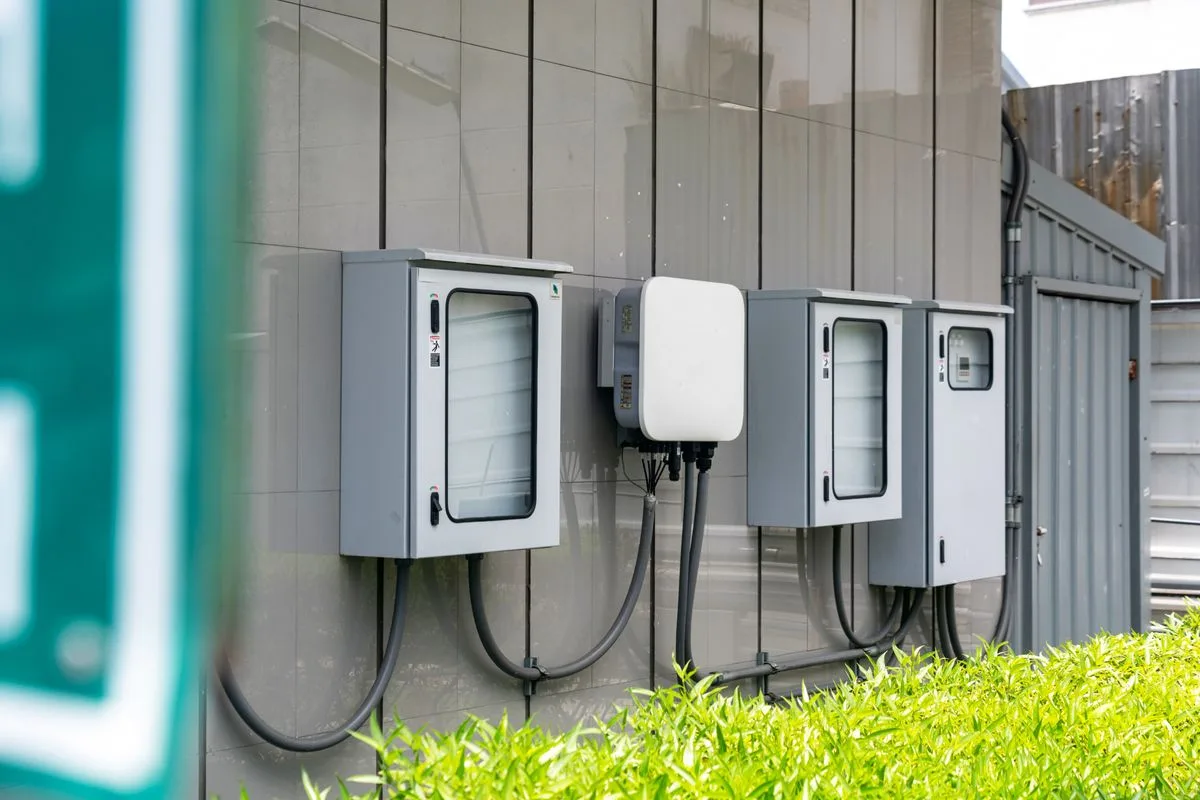
| Outdoor electrical cabinets | Sealed IP65 | ✅ Direct fit |
| Ventilated cabinets | Forced ventilation | 🔬 Case study |
| Inverters / UPS (sealed cabinet) | Sealed IP54-66 | ✅ Direct fit — measurable effect on MTBF |
| Inverters > 30 kVA | Forced ventilation | 🔬 Study or sealed sub-compartment |
| Outdoor equipment (telecom, instrumentation, sensors, cameras) | Sealed IP65+ | ✅ Direct fit — electronics + optics |
| Transformers and substations | Closed compartments | ✅ Direct fit on sensitive elements (terminals, bushings, switching) |
| Ventilated MV cells | Passive ventilation | 🔬 Case study |
| EV chargers — AC / wallbox | Sealed IP54/55, conduction-cooled | ✅ Direct fit |
| EV chargers — DC fast charge | Forced ventilation for dissipation | 🔬 Study or refocus on sub-compartment |
Our 85-day winter field study on 3 AC charging stations (24,385 measurements) illustrates the effectiveness in the sealed regime : RH variability divided by 3, time in condensation zone divided by 2.6.
Real-world case studies
Outdoor AC charging stations — 85-day IRVE validation
Three IP54 charging stations (95 L internal volume) equipped with 2 AS-C strips each were instrumented for 85 days in winter. Results :
- Time spent above 95 % RH : divided by 2.6
- RH standard deviation (variability) : divided by 3
- Spontaneous regeneration confirmed during spring warming
Maritime containers — 1-year CAPSA test
Uninsulated 10-foot containers equipped with AS-C tape were monitored for nearly one year. Internal RH maintained below 80 % throughout the entire test — total elimination of the “container rain” phenomenon.
Glossary
ISO 9223 : international standard that classifies atmospheric environments according to their corrosivity, from C1 (very low, conditioned indoor) to CX (extreme, direct marine exposure). Coastal zones typically fall under C5 (very high) to CX.
Deliquescence : phase transition of a solid salt into a saturated liquid solution, triggered when ambient relative humidity exceeds a threshold specific to each salt (75 % for NaCl, 33 % for MgCl₂).
SRD (Self-Regenerating Desiccant) : desiccant material — a mesoporous aluminum oxide — capable of adsorbing and desorbing water cyclically, without saturation, without maintenance, without energy input.
Thermal breathing : air exchange phenomenon between the inside and outside of a sealed enclosure, induced by daily temperature variations. Main cause of moisture ingress in an IP65+ enclosure. See our dedicated article.
IP65 / IP66 / IP67 : IEC 60529 protection indices against solids (first digit, 6 = dust-tight including aerosols) and liquid water (second digit). Do not qualify water vapor or gases.
Frequently asked questions
Does IP65 protect an electrical cabinet from salt aerosols at the seaside ?
Yes for particles. The first digit “6” of IP65 means dust-tight — salt aerosols (0.1 to several µm) are largely excluded, and the largest particles deposit by impaction in leak paths before reaching the interior. However, IP65 does not block water vapor, which enters freely via thermal breathing and polymer diffusion.
At what humidity level does salt become corrosive ?
From its deliquescence point : ~75 % RH for sodium chloride (NaCl) and ~33 % RH for magnesium chloride (MgCl₂). Below these thresholds, the salt remains solid and nearly inert. Above, it forms a conductive brine that destroys passive films and triggers pitting corrosion.
Do you need a desiccant in a sealed electrical cabinet at the seaside ?
Yes, and the humidity target is more demanding than in non-salt environments. Where a 60-65 % RH target is usually sufficient to prevent condensation, you must target below 60 % RH in the presence of marine salts to stay below the MgCl₂ deliquescence point. The AS-B sticker or AS-C ribbon, sized to the protected volume, reach this target passively without energy or maintenance.
What’s the difference between AirSponge and a silica gel sachet in a salt environment ?
Silica gel saturates in a few weeks (typically 2 to 8 depending on volume and climate) and then becomes dead weight without action. The SRD material of AirSponge regenerates cyclically : it adsorbs moisture during peaks and releases it during dry phases, indefinitely. In coastal environments, where the water load is continuous, automatic regeneration is a decisive criterion.
Does a coastal EV charging station fall under direct AirSponge fit ?
It depends on the thermal architecture. AC chargers / wallboxes are typically IP54-55 sealed (conduction cooling) → direct fit. DC fast chargers are often ventilated to dissipate power → case study required, or refocus on sealed sub-compartments (control, communication, metering). Our 85-day EV charger study documents the AC case in winter.
How to protect a transformer or distribution substation at the seaside ?
Closed compartments (terminals, bushings, switching gear) fall under direct AirSponge fit — humidity kept below the deliquescence point. Ventilated cells or kiosks fall under case study, often with a protection strategy targeted on the most critical sub-compartments.
In summary
Sealing alone is not enough : the enclosure breathes, and condensation comes from inside.
Water vapor enters — but not salt aerosol in an IP65 enclosure — and the reliability lever consists in keeping internal RH below the deliquescence point, which neutralizes the chloride by depriving it of electrolyte.
For sealed enclosures, AirSponge directly attacks this common root cause of coastal failures.
For ventilated enclosures, feasibility is determined case by case, by comparing the air renewal rate to the regeneration capacity — because ventilation handles temperature, never humidity.
Do you deploy equipment in marine or coastal environments (C5/CX) ?
- 🔒 Sealed enclosure : contact us for AirSponge sizing and B2B samples.
- 💨 Ventilated enclosure : we conduct a preliminary feasibility study. Request a study.
See also : Complete guide to preventing condensation in electrical enclosures — 6 methods compared with lab data.