How to prevent condensation in enclosures
Why IP65 and IP67 enclosures still get condensation
IP ratings protect against water — not water vapor
An IP65-rated enclosure is dust-tight and resists water jets. IP67 survives temporary immersion. But neither standard addresses water vapor.
The IEC 60529 test protocol evaluates resistance to liquid water and solid particles. It does not test for humidity ingress, vapor diffusion, or condensation behavior. In practice, no sealed enclosure is perfectly airtight — polymer gaskets, cable glands, and material interfaces all allow slow gas exchange with the surrounding environment.
This distinction matters: an enclosure can pass IP67 certification and still develop condensation within weeks of outdoor deployment. For a detailed look at what the IP rating actually measures and its limits against humidity, see our dedicated article.
The “thermal breathing” cycle
The primary mechanism is thermal breathing. During the day, solar radiation heats the enclosure. Internal air expands and escapes through micro-gaps in seals and cable entries. At night, the enclosure cools. Internal pressure drops, drawing in ambient air — which carries moisture.
Over successive day/night cycles, moisture accumulates inside the enclosure. For an in-depth analysis of the phenomena and origins of condensation in IP enclosures, see our support article. When the internal temperature drops below the dew point, water condenses on the coldest surfaces: PCBs, connectors, lens assemblies.
Lab test: IP65 vs IP67 under controlled humidity
To quantify this effect, we tested two commercial enclosures (IP65 and IP67) in a climate chamber. Both were sealed according to manufacturer specifications with no deliberate openings.
Protocol: enclosures placed in a saturated environment (>95% RH) at 0°C for 24 hours, then subjected to a thermal ramp.
Results: both enclosures showed internal humidity above 85% RH within 12 hours. The IP67 enclosure performed marginally better during the initial hours due to tighter gasket compression, but converged to similar humidity levels over 24 hours. Condensation droplets were visible on internal walls in both cases.
Conclusion: IP ratings delay moisture ingress but do not prevent it. Any enclosure deployed outdoors will eventually reach equilibrium with ambient humidity.
The real cost of condensation in electronics
Condensation inside sealed enclosures triggers a cascade of failure modes:
Electrical failures. Water bridges between traces on a PCB create leakage currents. At voltages below 50V, this causes signal degradation and parasitic discharge. Above 50V, short circuits can destroy components permanently.
Corrosion. Moisture combined with ionic contaminants (flux residues, salt spray, pollution) accelerates electrochemical corrosion on copper traces, solder joints, and connector pins. Corrosion is progressive and often invisible until the circuit fails.
Optical degradation. CCTV cameras, LiDAR sensors, and machine vision systems lose image quality when condensation forms on lens assemblies or protective windows. In surveillance applications, this creates blind spots during the critical early morning hours when condensation peaks.
Battery drain. In battery-powered IoT sensors, leakage currents from moisture cause parasitic discharge that reduces battery life by 20-40%, triggering premature field replacements.
An industry estimate places approximately 40% of environmental failures in industrial sensors as linked to internal condensation. The cost is not just the component — it is the truck roll, the downtime, and the warranty claim.
Before examining these 6 methods, see also our market overview of anti-humidity products for IP enclosures which covers the broader product landscape.
6 humidity control methods compared
1. Silica gel packets
How it works. Silica gel is a porous form of silicon dioxide that adsorbs water vapor through physical attraction. Standard sachets (1-10g) are placed inside the enclosure during assembly.
Performance. Silica gel works well initially. In our lab comparison, a 5g sachet inside a 1L IP65 enclosure maintained relative humidity below 60% for approximately 72 hours under cycling conditions (30°C day / 5°C night, 80% ambient RH).
After saturation, performance drops to zero. The sachet becomes inert weight. In a sealed outdoor enclosure, saturation typically occurs within 2-8 weeks depending on climate and enclosure volume. To visualize the difference in behavior between silica gel and SRD under humidity cycling, see the adsorption isotherm animation.
Limitations.
- No regeneration in situ — requires manual replacement
- No visual indicator of saturation in most designs (color-indicating variants exist but are less common)
- Generates recurring waste (a blind spot in eco-design): ~30 sachets over 10 years for a single enclosure
- Limited useful capacity above 60% RH where condensation risk is highest
Best for: short-term protection during shipping and storage, low-humidity indoor environments, or as a temporary measure before a permanent solution is installed.
Typical unit cost: €0.10-0.30 per sachet + labor for periodic replacement.
2. Pressure compensation vents (Gore PolyVent and equivalents)
How it works. A pressure compensation vent using an ePTFE (expanded polytetrafluoroethylene) membrane is integrated into the enclosure wall via a screw-in, snap-in, or adhesive vent. The membrane is hydrophobic — it blocks liquid water and dust while allowing air and water vapor to pass through. This equalizes pressure differentials caused by thermal cycling, reducing mechanical stress on seals.
Performance. Pressure vents are effective at preventing seal fatigue and extending gasket lifespan. However, they do not remove humidity from the enclosure. They equalize pressure, which means humid air can flow in as easily as out.
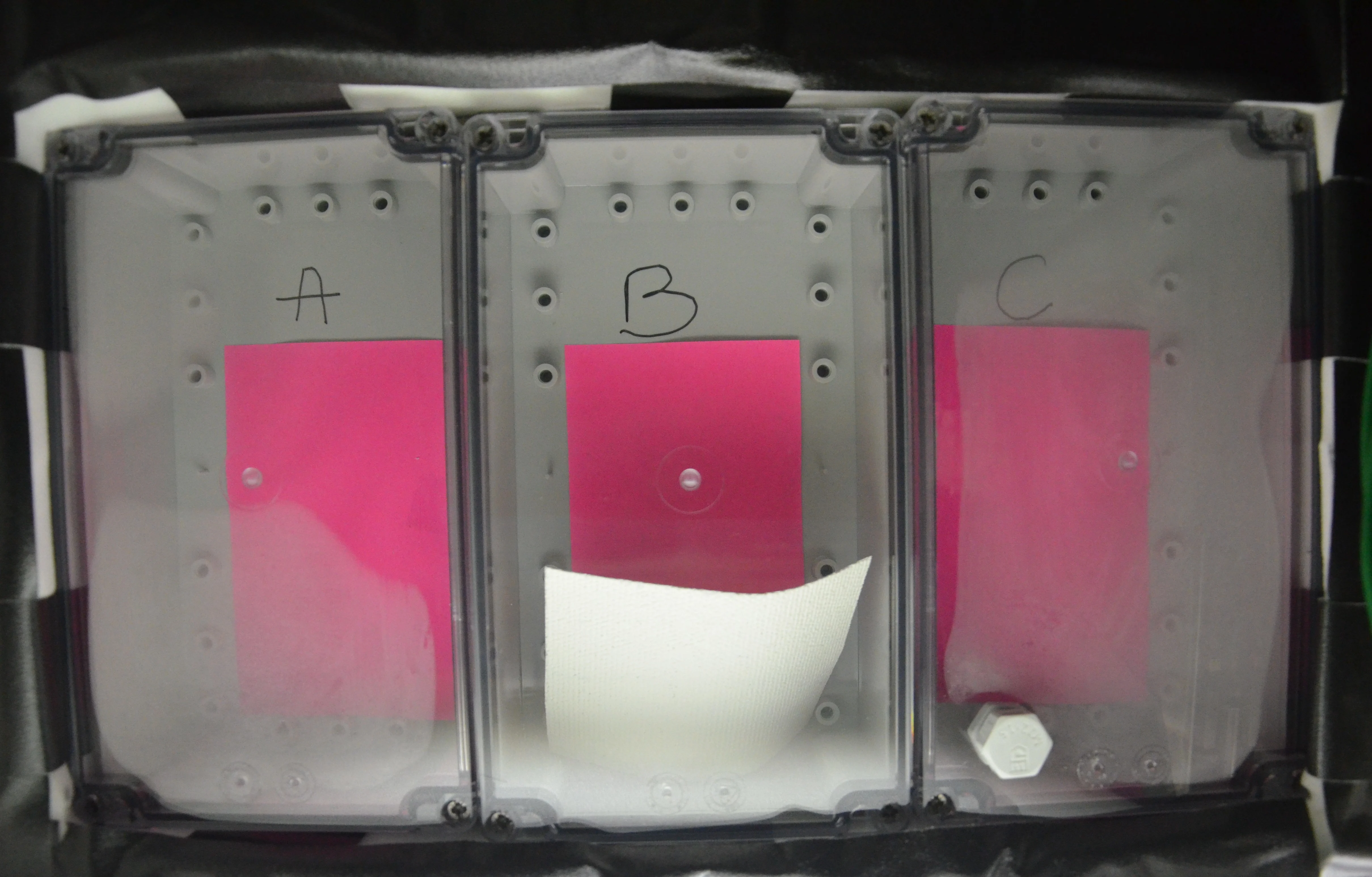
In our climate chamber test (3 identical IP66 enclosures, ramp from 30°C to 0°C over 80 minutes):
- Empty enclosure: condensation observed
- Enclosure with pressure vent: condensation observed
- Enclosure with SRD desiccant sticker: zero condensation
Read the full climate chamber test — protocol, curves and photos.
The vent equalized pressure successfully but did not prevent the humidity from condensing when the temperature crossed the dew point.
Limitations.
- Does not adsorb or remove moisture — only equalizes pressure
- Requires drilling a hole in the enclosure wall (not always feasible on deployed equipment)
- Membrane can become contaminated by oil, solvents, or fine particulates over time
Best for: preventing seal degradation in enclosures subject to rapid thermal cycling or altitude changes. Works well as a complement to a desiccant, not as a standalone humidity control solution.
Typical unit cost: €5-15 per vent + assembly labor.
3. Enclosure heaters + hygrostats
How it works. An electric heater (10-400W depending on cabinet volume) is installed inside the enclosure, controlled by a hygrostat that activates heating when relative humidity exceeds a threshold (typically 65% RH). By raising the internal temperature a few degrees above ambient, the relative humidity drops below the dew point, preventing condensation.
Major manufacturers include Stego, Pfannenberg, and nVent/Hoffman, all offering standardized product lines for DIN-rail mounting in industrial cabinets.
Performance. This is a proven, widely deployed approach in large electrical cabinets (automation, power distribution, telecom shelters). It works reliably when properly sized and maintained.
Limitations.
- Requires a power supply — not suitable for battery-powered or remote installations
- Continuous energy consumption: a 50W heater cycling 30% of the time consumes
130 kWh/year (€40-65/year in EU electricity costs). Larger cabinets with 200-400W heaters reach €150-525/year - Adds heat to the enclosure, which can stress temperature-sensitive components
- Hygrostat failure = no protection (single point of failure)
- Requires periodic maintenance: hygrostat calibration, heater element inspection
Best for: large industrial cabinets (>100L) with permanent power supply, where the energy cost is justified by the value of protected equipment.
Typical system cost: €50-200 for heater + hygrostat + installation labor + recurring electricity.
4. Ionic membrane micro-dehumidifiers (Rosahl and equivalents)
How it works. A solid polymer electrolyte (SPE) membrane decomposes water molecules on one side using a low-voltage DC current (3V). Hydrogen ions migrate through the membrane and recombine with oxygen on the other side, effectively pumping moisture out of the enclosure at the molecular level.
Performance. Rosahl membranes are maintenance-free with no moving parts, no noise, no vibration, and no condensate to drain. They are effective for enclosure volumes from 0.25L to approximately 8m³, depending on the membrane size selected.
Power consumption is low (typically 0.5-4W depending on model), making them viable for applications with available DC power.
Limitations.
- Requires a DC power source — not suitable for fully passive installations
- Dehumidification rate is limited by membrane area and ambient conditions
- Higher unit cost than passive alternatives
- Less effective in very high humidity environments (>90% RH sustained)
- Membrane must interface with the exterior — requires a wall-mounted installation
Best for: small-to-medium enclosures where a DC power source is available and zero-maintenance is required. Particularly suited to display cases, instrumentation cabinets, and telecom equipment.
5. Self-regenerating desiccant (SRD)
How it works. A mesoporous SRD material (aluminum oxide) captures water vapor through capillary condensation when relative humidity exceeds approximately 60%. Unlike silica gel, the pore geometry is engineered so that adsorbed water is released spontaneously when ambient humidity drops — no heat, no power, no intervention required. The adsorption/desorption cycle repeats indefinitely.
Performance. In the critical > 60% RH zone (where condensation risk is highest), SRD material offers approximately 6 times the useful adsorption capacity of silica gel.
Lab results across three independent tests:
- Climate chamber (IP66, 30°C→0°C ramp): zero condensation with SRD vs. visible condensation with pressure vent and empty control
- Silica gel comparison (1L enclosure, cycling conditions): SRD maintained RH below critical threshold throughout the test period; silica gel saturated and lost effectiveness after 72 hours
- IP65/IP67 comparison: SRD compensated for the humidity ingress observed in both enclosure ratings
Field validation:
- EV charging stations: 85-day winter deployment across 3 outdoor IP54 stations, 24,385 sensor readings. Time spent above 95% RH was reduced by a factor of 2.6. RH variability (standard deviation) reduced by a factor of 3. Spontaneous regeneration confirmed during spring desorption phase.
- Maritime containers (CAPSA): nearly 1 year of testing in uninsulated 10ft containers. RH maintained below 80%, eliminating the “container rain” phenomenon throughout the entire test period.
Limitations.
- Relatively new technology — limited long-term field data beyond 2 years
- Not yet UL Recognized (qualification in progress)
- Requires minimum air circulation within the enclosure for optimal performance
- Does not actively pump moisture out — it buffers and regulates
Best for: any sealed IP65+ enclosure from 0.5L to 100L+ (sticker format for small enclosures, tape format for large volumes). Ideal where zero power, zero maintenance, and long-term autonomous operation are required.
Format and cost: self-adhesive sticker or tape, one-time installation, no recurring cost.
6. Potting / resin encapsulation
How it works. The board is fully embedded in a resin (epoxy, polyurethane, silicone): no internal air remains, so there is no water vapor left to condense. This is mechanical exclusion of humidity, not regulation.
Performance. Highly effective against condensation — and multifunction: potting also provides mechanical/vibration resistance, enhanced dielectric insulation and a chemical barrier. A proven process, qualified in aerospace, defense and automotive.
Limitations.
- Irreversible: the board cannot be repaired or diagnosed — a single component failure condemns the whole module.
- Thermomechanical stress: the CTE mismatch between resin and components can crack solder joints and interfaces over thermal cycles.
- Degraded thermal management (trapped heat), a heavy process (degassing, curing, added mass), and a composite waste that is hard to recycle.
Best for: cases where you need at least one of potting’s other functions (mechanical, dielectric, chemical, liquid-water protection). Conversely, if you pot only against condensation, you pay for a multifunction process to obtain a single one of its functions — a passive regulator (SRD) achieves the same result without freezing the electronics. Detailed analysis: Potting vs passive anti-condensation: when do you really need potting?.
Side-by-side comparison
| Criterion | Silica gel | Gore PolyVent | Heater + hygrostat | Rosahl membrane | Potting (resin) | SRD (AirSponge) |
|---|---|---|---|---|---|---|
| Absorbs humidity | Yes (until saturated) | No (equalizes pressure) | No (evaporates) | Yes (pumps out) | No (excludes air) | Yes (6× silica gel in risk zone) |
| Self-regenerating | No | N/A | N/A | N/A | N/A | Yes |
| Energy consumption | 0W | 0W | 10-400W | 0.5-4W | 0W | 0W |
| Maintenance required | Replace every 2-8 weeks | None (inspect yearly) | Monitor hygrostat + heater | None | None (fit-and-forget) | None |
| Lifespan | ~6 months per sachet | 3-5 years | 5-10 years (heater element) | 10+ years | Permanent | Unlimited |
| Installation | Drop-in sachet | Drill + mount | Wiring + DIN rail | Wall mount + DC wiring | Encapsulation + curing | Peel and stick (10 seconds) |
| Enclosure modification | None | Hole required | Hole + power entry | Hole + power entry | Fills the volume | None |
| Recurring cost | High (sachets + labor) | Low | High (electricity) | Low (electricity) | None | None |
| Works without power | Yes | Yes | No | No | Yes | Yes |
How to choose: decision framework
Step 1 — Enclosure volume
- Under 1L: SRD sticker (10 cm²) or silica gel
- 1L to 20L: SRD stickers, Rosahl, or heater
- Over 20L / cabinets: SRD tape, heater + hygrostat, or Rosahl (multiple units)
Step 2 — Power availability
- No power available: SRD or silica gel (SRD preferred for long-term)
- DC power available: Rosahl or SRD
- AC power available: all options viable
Step 3 — Maintenance tolerance
- Zero maintenance required: SRD or Rosahl
- Periodic maintenance acceptable: heater + hygrostat or silica gel
Step 4 — Installation constraints
- Cannot drill the enclosure: SRD (adhesive) or silica gel (drop-in)
- Can modify the enclosure: all options viable
Step 5 — Budget model
- Lowest upfront cost: silica gel
- Lowest total cost of ownership (5-year horizon): SRD
- Highest ongoing cost: heater (electricity) or silica gel (replacement labor)
See our detailed comparison for a full performance analysis.
For enclosures already equipped with a pressure vent: adding an SRD sticker provides the humidity control the vent cannot deliver on its own. The two solutions are complementary, not competing. See what a Gore vent does and does not do.
Not sealed? IP54 and ventilated enclosures
Many enclosures are not IP65 at all: IP54 cabinets, EV chargers, kiosks, instrumentation housings with louvres. Is a desiccant still worth it when the enclosure exchanges air with the outside all day?
The principle does not change, the target does. In an IP54 enclosure, the internal humidity follows the outside more closely, and a desiccant cannot dry the outside air. What it can do is clip the humidity peaks during the cold, humid hours: capture vapour when the internal air climbs above about 60 % RH, hold it while the enclosure is cold, and release it when it warms up. The goal is to shorten the time spent near saturation, not to keep the air dry permanently.
The surface must be larger. Every air exchange brings new vapour, so each peak is bigger than in a sealed box. Up to 20 L, use AS-B stickers with generous margin over the one-per-litre starting rule; above 20 L, use the AS-C ribbon.
It is documented. In three IP54 EV chargers of 95 L, with 0.32 m² of AS-C ribbon each (16 stickers), the time above 95 % RH was divided by 2.6 over 85 winter days, the humidity variability by 3, and the correlation between inside and outside humidity fell from 0.54 to 0.02 (full study).
When it is not worth it. Enclosures with forced ventilation, fans or large openings (IP2x, IP3x) renew their air too fast for any passive buffer. There, a heater with a hygrostat, or better sealing, is the right answer.
For an IP54 or ventilated enclosure, sizing depends on the air exchange rate: ask for a free study.
Real-world case studies
Defense and aerospace — qualification in progress
A leading European defense and aerospace group is qualifying the SRD sticker for enclosures subject to severe thermal cycles in field conditions. Internal validation is ongoing, with preliminary results confirming condensation elimination under MIL-standard temperature profiles.
Read the case study: Condensation on industrial equipment — Thales study.
EV charging stations — 85-day winter field test
Three outdoor AC charging stations (IP54, 95L enclosure volume, 0.32 m² of AS-C ribbon per unit, i.e. 16 stickers) were monitored over 85 days during winter in France. Four sensors per station recorded temperature and humidity at 5-minute intervals — 24,385 data points total.
Key results:
- Time above 95% RH reduced by a factor of 2.6
- RH variability (σ) reduced by a factor of 3
- Indoor/outdoor humidity correlation dropped from 0.54 to 0.02 (near-total decoupling)
- Spontaneous regeneration observed during spring warming phase
Read the full study: AS-C validation on EV charging stations — 85 days of winter.
Maritime containers — CAPSA 1-year test
Uninsulated 10ft shipping containers equipped with SRD tape were monitored for nearly one year. Result: relative humidity maintained below 80% throughout the test, with zero occurrence of “container rain”
Read the full study: Humidity control in containers — CAPSA test.
Note: — the condensation dripping phenomenon that typically damages stored goods during transit and seasonal temperature shifts.
Frequently asked questions
Can I combine a pressure vent with a desiccant? Yes — this is often the optimal configuration. The pressure vent handles pressure equalization and protects seals, while the desiccant handles humidity regulation. Our climate chamber tests confirmed that the vent alone does not prevent condensation; adding an SRD sticker eliminated it completely.
Is a desiccant useful in an IP54 enclosure that is not sealed? Yes, as long as the enclosure is not force-ventilated. It will not keep the air dry, but it clips the humidity peaks during cold, humid hours. In IP54 EV chargers, the time above 95 % RH was divided by 2.6 over 85 winter days. The surface must be larger than in a sealed box.
How long does silica gel last in a sealed outdoor enclosure? Typically 2-8 weeks before saturation, depending on ambient humidity, enclosure volume, and sachet size. In tropical or coastal environments, saturation can occur within days.
Does IP69K prevent condensation? No. IP69K adds resistance to high-pressure, high-temperature water jets (steam cleaning). It does not address water vapor diffusion or thermal breathing. An IP69K enclosure deployed outdoors will develop condensation through the same mechanisms as IP65 or IP67.
At what humidity level does condensation damage electronics? The critical zone begins around 60% RH. Above this relative humidity level, electrochemical corrosion accelerates significantly. Condensation (liquid water formation) occurs when RH reaches 100% locally — typically at the coldest point inside the enclosure (cold spot condensation). The goal is to maintain internal RH well below 60% to provide a safety margin.
What is the difference between a desiccant and a dehumidifier? A desiccant adsorbs moisture passively through chemical or physical attraction. A dehumidifier actively removes moisture using energy (compression, heating, or ionic pumping). SRD material is technically a desiccant, but its self-regenerating property gives it the functional behavior of a maintenance-free dehumidifier.