Potting or passive anti-condensation: when do you really need potting?
Key takeaways
- 🧩 Potting is multifunction: mechanical hold, dielectric insulation, chemical barrier, liquid water, zero maintenance. On those functions, nothing replaces it.
- 💧 But against condensation it works by exclusion (filling the volume to remove the air) — and that is irreversible, heavy, and a source of thermomechanical stress.
- 🔁 If you pot only out of fear of condensation, you pay for a multifunction process to obtain a single one of its functions.
- ✅ The SRD AS-B sticker regulates humidity below the dew point (reversible, no added stress, thermal dissipation preserved) — the same anti-condensation result, without freezing the electronics.
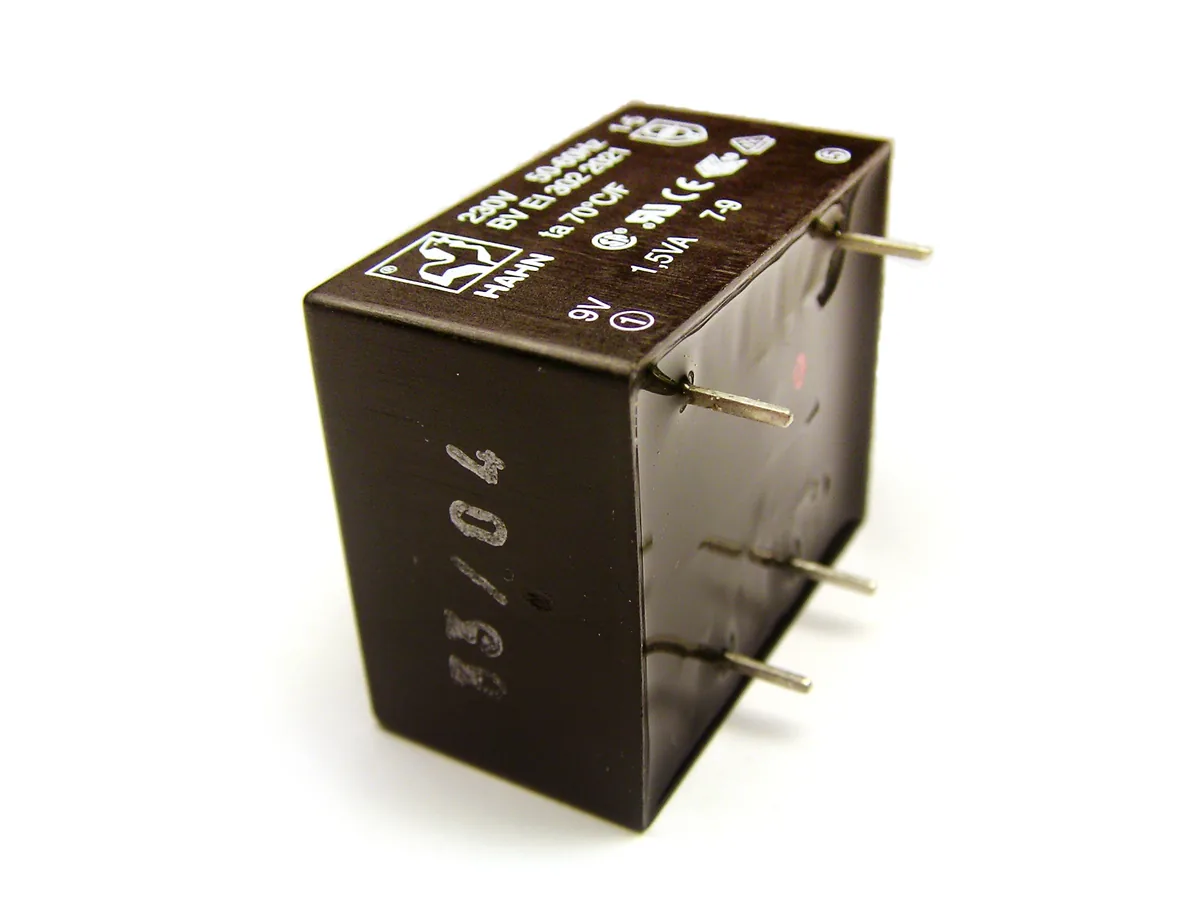
To protect a circuit board inside a sealed enclosure, potting is often the reflex choice: embed the whole assembly in a resin — epoxy, polyurethane or silicone — to shield the components. It is a proven process, qualified in aerospace, defense and automotive, and it does its job perfectly.
So well, in fact, that it is often used for far more than what is actually needed. Because potting is a multifunction solution — and condensation is only one of the functions it covers. The real question is therefore not “to pot or not to pot?”, but: for how many of those functions are you really paying?
What potting does well — and what AS-B does not
To be fair: on several fronts, potting has no equivalent, and the AS-B sticker does not claim to replace it.
Mechanical hold and vibration resistance. The resin bonds the components to the board and the enclosure. On heavy elements — capacitors, transformers, connectors — it eliminates solder-joint fatigue under vibration and shock. AS-B does not hold the electronics: it manages the air. On this point, no comparison is possible.
Dielectric insulation. For high-voltage or high-density electronics, the resin increases dielectric strength, suppresses creepage paths and allows traces to be brought closer together. This is sometimes a full electrical-design decision in its own right, independent of any humidity concern. (Standard IEC 60664-3 explicitly recognizes encapsulation as a means of insulation coordination.)
Complete chemical barrier. Corrosive atmospheres, salt, gases, conductive dust: the resin isolates from everything, not just water. AS-B regulates humidity; it does not protect against chemical agents. (For salt environments, see our dedicated analysis: salt-air corrosion.)
Liquid-water protection. In case of a frank ingress, potting protects. AS-B acts on the water vapor present in the internal air, not on incoming liquid water. That said, an enclosure correctly rated IP65+ and properly assembled is, by definition, not supposed to admit liquid water in normal service — which is precisely the assumption AS-B operates under.
Certified “fit-and-forget”. Once qualified, potting requires no maintenance or monitoring. For inaccessible applications — buried module, sealed embedded unit, non-maintainable environment — that is a decisive argument.
If your specification requires mechanical hold, enhanced dielectric insulation or a chemical barrier, potting remains the right choice. This article does not try to steer you away from it.
But potting handles humidity by exclusion, not regulation
There remains the one function that, on its own, drives a large share of potting decisions: preventing condensation. And this is where the logic deserves to be re-examined.
Potting does not regulate humidity: it fills the internal volume so that no air — and therefore no water that could condense — is left. This is mechanical exclusion. Effective, but with a downside when it is the only motive:
Irreversibility. A potted board cannot be repaired or diagnosed. A single component failure condemns the whole module. No rework, no after-sales service — the IPC-7711/7721 repair standards do not cover fully encapsulated assemblies.
Thermomechanical stress. The resin’s coefficient of thermal expansion differs from that of the components. With every thermal cycle, these mismatches generate stresses that can crack solder joints and delaminate interfaces — the very failure mode you were trying to avoid.
Thermal management. The resin traps heat around power components, which can accelerate their ageing.
Heavy process. Metering, vacuum degassing, curing time, added mass, dedicated line.
End of life. A resin-plus-electronics block is a composite waste, hard to repair or recycle — against the rising tide of eco-design requirements.
These mechanisms — CTE mismatch and delamination under thermal cycling, low thermal conductivity of unfilled resins, recycling difficulty of thermosets — are documented in the literature (Polymers, MDPI, 2023). These drawbacks are perfectly acceptable when you also buy potting’s other functions. They are much less so when you were potting only for condensation.
AS-B: managing the dew point rather than removing the air
AS-B starts from a different premise. An IP65+ enclosure is not airtight over time: it breathes. Under day/night thermal cycling, internal pressure varies and humid air eventually gets in. We studied this breathing of IP65 enclosures: depending on the materials (gaskets, cable glands) and the climatic conditions, an IP65 enclosure tends toward equilibrium with the outside air with a time constant ranging from a few days to a few weeks. Humidity will get in — it is mechanical. The IP rating (standard IEC 60529) only qualifies resistance to solids and liquid water, never to water vapor; and experimental work shows that the internal humidity of an enclosure tends toward equilibrium with the ambient air, opening the way to condensation below the dew point (Rasmussen et al., IEEE Trans. CPMT, 2020).
Rather than excluding this air, AS-B acts on the only variable that actually triggers condensation: it keeps the internal relative humidity below the dew point. The SRD material loads during humid phases, then regenerates during the warm, dry phases of the cycle. Condensation does not form — so there is nothing to exclude.
Where a silica gel saturates and gives up as soon as conditions become severe, the SRD acts as a hygroscopic shock absorber: it absorbs the humidity shocks of thermal cycles and releases them afterwards, with a useful capacity on the order of 8× that of silica gel in the useful zone, 60–90% relative humidity — a behavior (type-IV isotherms rising steeply above about 60% RH, reversible adsorption/desorption cycling) consistent with the literature on mesoporous aluminas.
In this precise niche — regulating the humidity of the internal air — AS-B offers what potting cannot: reversibility, no added thermomechanical stress, preserved thermal dissipation, a radically simple process, and a product that is repairable and removable at end of life.
The comparison at a glance
| Criterion | Potting (resin) | AS-B sticker |
|---|---|---|
| Principle | Exclusion: fill the volume to remove the air | Regulation: keep humidity below the dew point |
| Protection against condensation | Yes (by exclusion) | Yes (by regulation, with regeneration) |
| Liquid-water / immersion protection | Yes | No (acts on the vapor in the internal air) |
| Mechanical hold / vibration resistance | Yes (bonds the components) | No |
| Enhanced dielectric insulation | Yes | No |
| Chemical barrier (salt, gas, corrosion) | Yes | No |
| Reversibility / repairability | No (irreversible) | Yes (peel and replace) |
| Diagnostics & rework after assembly | Impossible | Possible |
| Added thermomechanical stress | Yes (CTE mismatch) | None |
| Thermal dissipation | Degraded (trapped heat) | Preserved |
| Duration / regeneration | Single bet at the factory | Regenerates every cycle |
| Implementation process | Heavy (metering, degassing, curing) | Apply an adhesive |
| Cost (at manufacturing) | ~€2-15/unit (resin + process), one-time | Low unit cost, one-time application |
| Added mass | Significant | Negligible |
| Maintenance | None (fit-and-forget) | None (self-regenerating) |
| End of life / recyclability | Composite waste | Removable, repairable |
| Standards maturity | High (aero, defense, auto) | Qualification in progress |
In summary: potting ticks almost every box because it is multifunction. AS-B ticks fewer — but on humidity regulation, it brings everything potting cannot offer.
The right decision framework
Potting and AS-B do not play in the same category, and that is exactly what makes the choice clear:
- Potting is multifunction: mechanical, dielectric, chemical, liquid water, anti-vibration, maintenance-free. If you need one or more of these functions, it remains the right tool.
- AS-B is single-function, but excellent at that function: regulating the humidity of the air, while preserving everything that potting freezes.
The question to ask in design is therefore not “which is better?” but: why are you potting? If it is for mechanical hold, dielectric insulation or a chemical barrier, keep the potting. If it is above all — or only — out of fear of condensation, then you are paying for a multifunction process for a single one of its functions, and you are freezing your electronics to exclude a humidity that, in reality, never needs to condense.
In that precise case, and only in that case, AS-B does the same job. Better.
To go further on the full set of methods, see our complete guide to preventing condensation in electrical enclosures — 6 solutions compared with lab data.
Glossary
Potting (encapsulation): process of embedding a circuit board in a resin (epoxy, polyurethane, silicone) to protect it mechanically, electrically and chemically. Irreversible once cured.
Exclusion vs regulation: potting excludes the air (and therefore water) by filling the volume; a regulating desiccant keeps the air humidity below a threshold without removing the air.
Dew point: the temperature at which cooling air reaches 100% relative humidity and water vapor condenses into liquid water. Keeping internal RH below this threshold prevents condensation. Learn more.
SRD (Self-Regenerating Desiccant): a desiccant material — mesoporous aluminum oxide — that adsorbs then desorbs water cyclically, without saturation or maintenance, unlike silica gel.
Thermal breathing: air exchange between the inside and outside of a sealed enclosure, induced by temperature variations. The main cause of moisture ingress in an IP65+ enclosure. Dedicated article.
Frequently asked questions
Does potting really prevent condensation? Yes, by exclusion: by filling the internal volume, it leaves no air — and therefore no water vapor that could condense. But it is an irreversible protection that freezes the electronics. If condensation is your only reason for potting, a passive humidity regulator achieves the same result without the drawbacks (reversibility, thermal, repairability).
When does potting remain essential? As soon as you need at least one of its other functions: mechanical / vibration hold on heavy components, enhanced dielectric insulation (high voltage, high density), chemical barrier (salt, gas, corrosion), liquid-water protection, or certified “fit-and-forget” for a fully inaccessible module.
What is the difference between AS-B and a silica gel sachet? Silica gel saturates once and for all, then becomes inert. The SRD material in AS-B regenerates with every thermal cycle (loads in the humid phase, releases in the dry phase) and offers about 8× the useful capacity of silica gel in the useful zone (60–90% RH). See also: desiccant pack lifespan.
Does AS-B protect against liquid water entering the enclosure? No. AS-B acts on the water vapor in the internal air, not on a liquid-water ingress. It operates under the assumption of an enclosure correctly rated IP65+ and properly assembled, which is not supposed to admit liquid water in normal service.
Isn’t an IP65 enclosure already airtight to humidity? No. The IP rating qualifies resistance to solids and liquid water, not water vapor. Through thermal breathing, humid air slowly gets in and the enclosure tends toward equilibrium with the outside air (time constant from a few days to a few weeks depending on materials and climate). Condensation therefore ends up forming if internal humidity is not regulated.
Can AS-B complement an already-vented enclosure or one fitted with a pressure compensation vent? The pressure compensation vent equalizes pressure and protects the seals, but does not remove humidity. AS-B is complementary: it regulates the humidity the vent lets in. See the condensation guide.
Sources and references
This article weighs two stances; here are the third-party sources that support them.
On potting (strengths and limits)
- A Brief Overview on Epoxies in Electronics: Properties, Applications and Curing, Polymers (MDPI), 2023 — benefits (dielectric, mechanical, environmental) and documented limits: CTE mismatch → stress and delamination under thermal cycling, low thermal conductivity of unfilled resins, recycling difficulty of thermosets. Open-access article
- IEC 60664-3 — insulation coordination: recognizes encapsulation/molding as a means of dielectric protection.
- IPC-7711/7721 — fully encapsulated assemblies are not repairable by standard rework processes.
- Technical guides from encapsulation-resin manufacturers (Henkel/LOCTITE, Electrolube/MacDermid, Master Bond, Wevo) — vibration and dielectric performance, and flexible resins chosen to limit CTE stress.
On humidity in IP enclosures and condensation
- IEC 60529 (IP rating) — only qualifies ingress of solids and liquid water, not water vapor.
- Rasmussen et al., Humidity Buildup in Electronic Enclosures Exposed to Constant Ambient Conditions, IEEE Trans. Components, Packaging and Manufacturing Technology, 2020 — experimental demonstration of internal humidity buildup up to equilibrium with ambient.
- Enclosure and vent manufacturers (Gore, Bud Industries, Spelsberg) — offer “IP-rated” membranes/vents precisely because the IP rating does not prevent internal condensation.
On mesoporous desiccants
- The adsorption behavior of mesoporous aluminas (type-IV isotherms rising steeply above about 70% RH, reversible cycling) is documented in the adsorption literature (dehumidification, heat pumps). The 8× useful capacity vs silica gel (useful zone, 60-90% RH) is an internal So Sponge measurement, consistent with this behavior.
AS-B is the sticker format of the passive AirSponge range, designed for small- and medium-volume IP65+ electronic enclosures. To size the protection suited to your volume and climate, contact the So Sponge team.