Infrastructure & Storage application
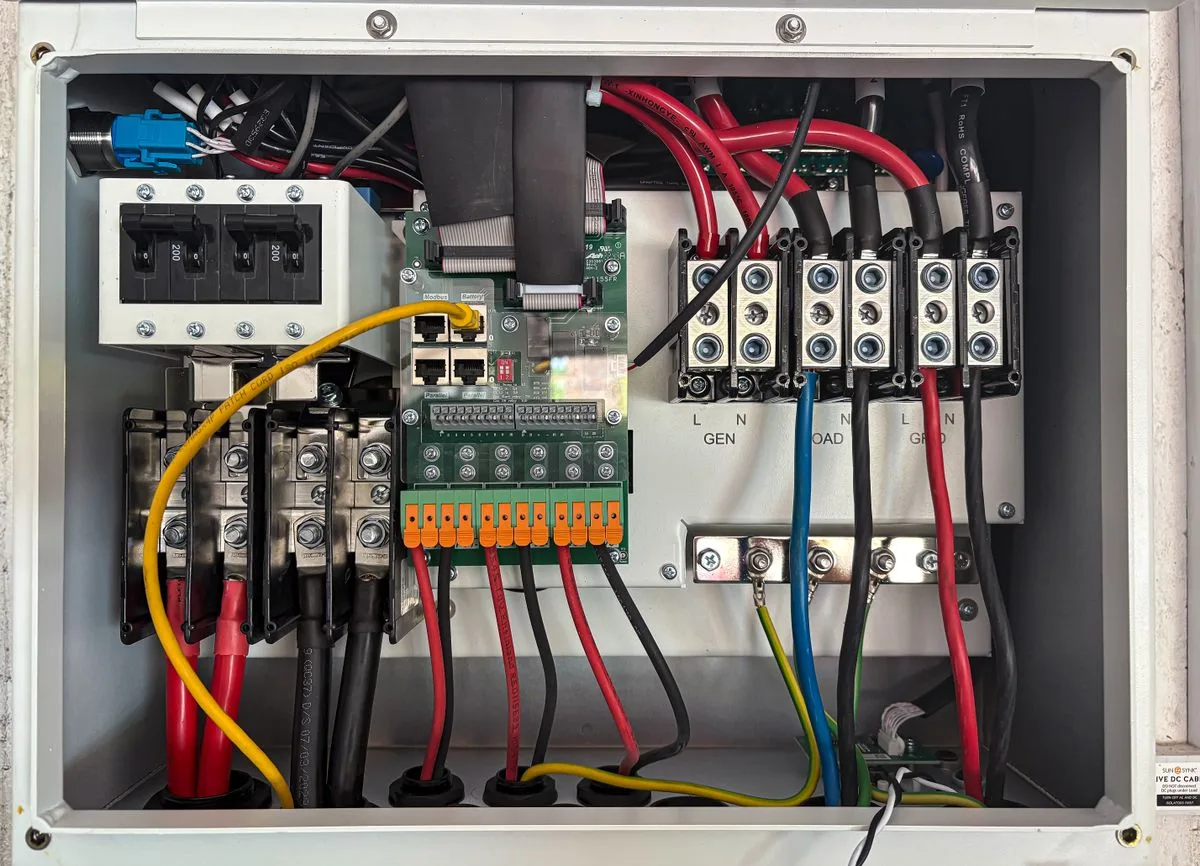
The solar combiner box — and every DC/AC protection box between the panels, the inverter and the switchboard — is the blind spot of photovoltaic installations: checked once a year, they condense unwitnessed the rest of the time. Moisture at the bottom of the box, corroded contacts, heating connections — up to unexplained fire incidents.
The AS-C ribbon (common boxes of 20 L and above) or the AS-B sticker (small boxes) is fitted at the bottom of the box, at installation or as a retrofit: adsorption above 60% RH, spontaneous regeneration. Zero energy, zero maintenance — the same preventive logic as fire protection.
The problem
A solar combiner box lives outdoors or in an unheated room, and goes through the same day/night thermal cycles as the inverter — without the internal heat dissipation that dries the inverter's air. By day, the internal air warms and escapes through micro-gaps; at night, the vacuum draws in humid outside air. And even with no breathing at all, the air sealed in at installation is enough: closed on a humid day, the box condenses on the first cold night.
Field feedback from installers and O&M operators converges on two findings. First, polymer (ABS) boxes are more affected than metal ones: their thermal behavior widens the wall/air temperature gaps, favoring local dew-point crossings. Second, the water ends up at the bottom of the box — condensed droplets run down to the lowest point, out of sight, right where the terminal blocks sit.
With one aggravating factor: the box is typically inspected once a year. Between two visits, condensation works for eleven months with no witness.
Terminal blocks, connections and protection devices oxidize on contact with moisture. Contact resistance rises, connections heat up, protections age prematurely.
A corroded or loose connection that heats up can strike an arc. In the industry's field experience, a share of PV fire incidents remains unexplained after investigation — internal box humidity is among the plausible contributors.
Nuisance tripping, insulation faults, incidents: every hour of downtime is unrecoverable production — and humidity-related damage is regularly excluded from equipment warranties.
Field state of the art
The reactive treatment observed in the field: blow out the visible water, protect the contacts. Effective on the day of the visit — condensation returns on the next thermal cycle.
Bulky in a dense box, saturated within weeks in the 60-90% RH zone, never replaced between yearly visits. A few weeks of protection for a 365-day problem.
Ventilating degrades the box's IP rating and lets in dust and humid air. On an electrical protection box, that is rarely acceptable.
Relevant in a large powered cabinet, disproportionate for a junction box: dedicated wiring, permanent consumption, one more failure point.
The solution
The AS-C ribbon (pre-adhesive 200 × 8 cm band, sized to the volume) and the AS-B sticker contain the SRD material (self-regenerating mesoporous aluminium oxide): it adsorbs water vapor from ~60% RH and keeps the box air below its dew point. The AC/DC boxes observed in the field are typically 30 to 500 L: the AS-C ribbon is the reference format there, with the AS-B sticker covering small boxes. In the warm hours it releases the captured moisture and regenerates — the cycle naturally follows the thermal cycle that causes the condensation.
Applied at the bottom of the box — where the water pools — at installation or as a retrofit during the yearly visit: no tools, no wiring, no maintenance afterwards. One reference per format, quantity adjusted to the box volume.
The logic is that of a preventive consumable, just like the fire protection or surge arrester fitted systematically: a few tens of euros per installation, to remove one link from the corrosion → heating → arc chain.
FAQ
Every closed box exposed to thermal cycles: the DC box between panels and inverter, the AC box between inverter and switchboard, junction and disconnect boxes. Unlike the inverter, they dissipate almost no heat to dry their internal air — condensation settles in all the more easily.
The IP rating blocks liquid water from outside, not the vapor in the air sealed inside nor what migrates through the seals over thermal cycles (see our IP-rating guide). When the walls cool at night, vapor condenses and droplets run down to the lowest point: water pools at the bottom of the box. ABS enclosures are more prone to it than metal ones, their thermal behavior widening the wall/air temperature gaps.
Indirectly, yes: humidity corrodes contact points; a corroded connection raises resistance, heats up, and can strike an arc. A share of PV fire incidents remains unexplained after investigation, and internal box humidity is among the plausible contributors. Keeping the box air below its dew point removes one link from that chain.
Common AC/DC boxes run 30 to 500 L: the reference format is the AS-C ribbon (pre-adhesive 200 × 8 cm band), in a length sized to the volume — a free sizing study is offered. The AS-B sticker (M or L) covers small boxes up to about twenty litres. Fitted at the bottom of the box, on a clean wall, in seconds.
Yes — the most common scenario for O&M operators: the sticker is fitted during the annual check, with no tools and no electrical modification. It does not repair existing corrosion, but stops it from worsening and protects the box until the next visit — where compressed air or silica gel only treat the day of the visit.
No. The SRD material is a passive mesoporous aluminium oxide, chemically inert and electrically neutral: no conductive path, no emissions, no change to the wiring or protection devices. REACH and RoHS confirmed on request.
Documented prevention is always a favorable element in an insurance file, in the same way as the fire protection or surge arrester fitted systematically. Some operators include box humidity control in their prevention policy and record it in maintenance reports.
The logic is that of an installation consumable: a single reference per format, quantity adjusted to the fleet. Unit sales and small packs through the online shop; volume pricing and dedicated MOQs for fleet deployments — a few tens of euros per installation at fitting time.
Evaluation
Evaluate the AS-C ribbon or the AS-B sticker on your own AC/DC boxes. So Sponge provides free samples for B2B technical evaluation, and offers a free sizing study for fleet deployments.
Further reading