IoT in agriculture: three cases of condensation in field electronics
Connected agriculture has a feature industrial IoT does not: its electronics live outdoors, with no shelter, and often on a living animal. An agricultural robot spends its days in the field and its nights under the dew. A connected tag stays clipped to a cow’s ear for years. A virtual-fencing collar is only removed for a few hours of maintenance. None of this equipment can be opened to change a silica gel pack.
In 2026, three manufacturers in this sector, on two continents, contacted us with the same symptom: humidity, then condensation, inside enclosures that were nonetheless sealed. We report these cases anonymously, limited to what is useful to any designer facing the same problem.
Why the open field is the worst case for a sealed enclosure
An IP65, IP66 or IP67 enclosure stops liquid water. It stops neither water vapour, which crosses polymer walls and seals by permeation, nor the “breathing” of the enclosure over thermal cycles. In agriculture, these cycles are violent:
- Day/night swings of 20 to 30 °C in summer, between an enclosure in full sun and the same wall cooled by radiation under a clear sky.
- Relative humidity close to 100 % at dawn, when dew settles on crops and equipment.
- Direct sunlight on dark enclosures, which heat the internal air well above ambient, then let it drop sharply.
- A loaded atmosphere: dust, mud, and for anything touching the animal, ammonia from urine.
- No maintenance possible: nobody opens a tag fitted to a herd, and a robot has no desiccant replacement schedule.
The result is mechanical. Every night, the air trapped in the enclosure cools to its dew point and water settles on the coldest surface: a camera lens, a transparent wall, a circuit board. In the morning everything evaporates, and the cycle starts again. Over years, that means corrosion, sensor drift and fogged optics.
Case 1: the autonomous agricultural robot
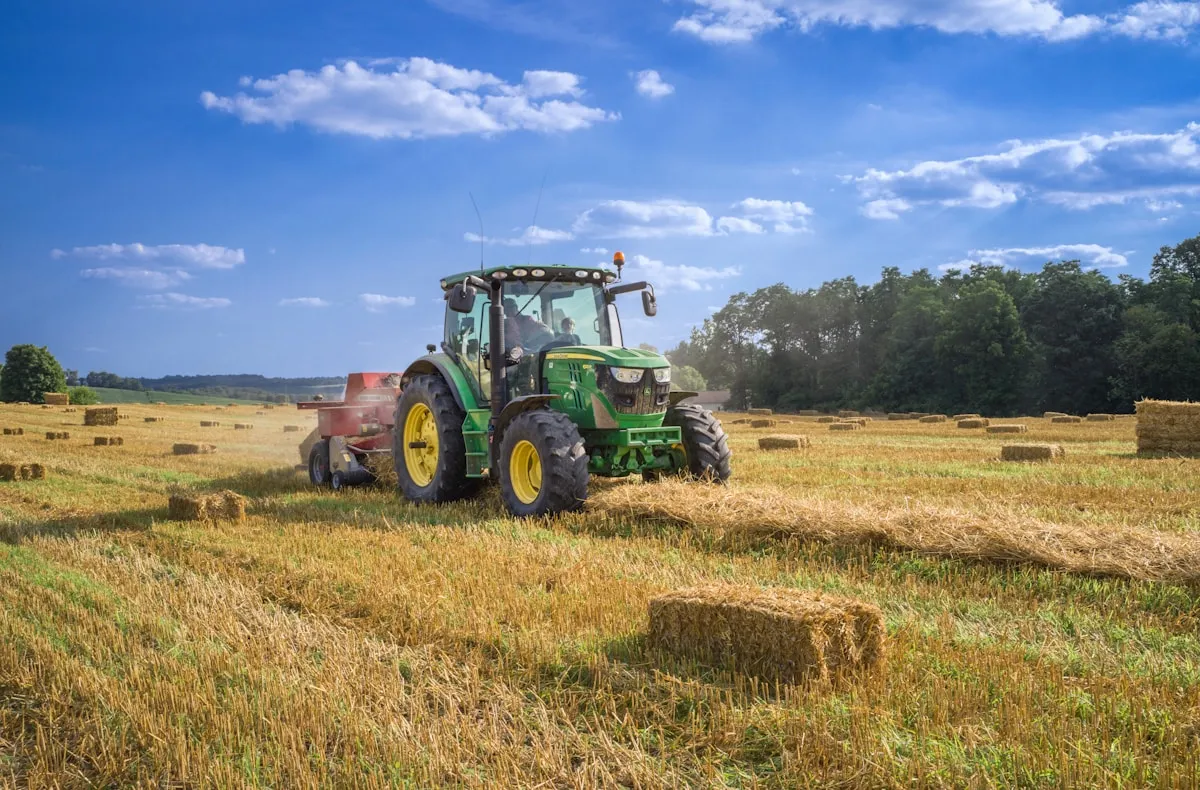
A European manufacturer of autonomous agricultural machines, fitted with vision systems, had recurring condensation problems in the on-board electronics of its vehicles: sealed metal enclosures, exposed in the field day and night. Conventional methods, silica gel and pressure compensating plug, had been tried without solving the problem.
This is the most advanced of the three cases. The manufacturer ran its own comparative tests between the SRD sticker and a conventional desiccant, in instrumented enclosures under temperature cycling. Its conclusion is positive and the technology is validated by the manufacturer: the subject has moved from the laboratory to industrialisation. The test data belongs to the manufacturer and remains confidential.
One lesson is worth sharing: a consumable desiccant, delivered dry, always wins the first hours of a test. It is the behaviour over several weeks, under thermal cycling, that separates a consumable that saturates from a material that regenerates.
Case 2: the solar-powered tag worn by the animal
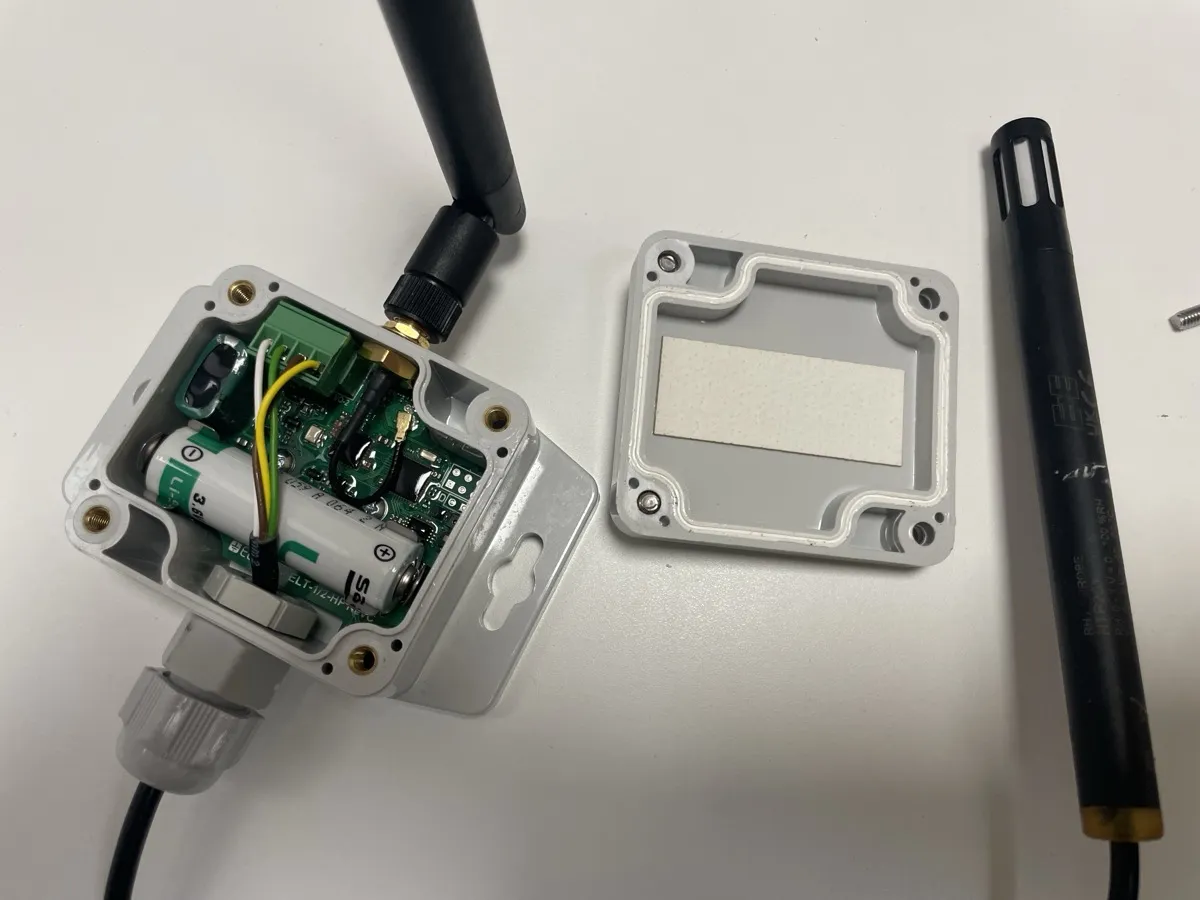
A designer of animal-worn sensors, for herd monitoring, works at the other end of the scale: a polycarbonate enclosure of a few cubic centimetres, almost entirely filled by the electronics and the battery, with a transparent face to feed a solar panel. No vent, for fear of a membrane clogging with dirt. Conventional desiccants had been ruled out: they saturate too quickly to be usable in a product that never opens.
Its most instructive observation concerns the moment condensation appears: in clear, sunny weather, when the device is lying idle, off the animal. The dark solar panel heats the internal air, but the transparent face turned towards the sky radiates its heat away and becomes the cold surface on which the vapour condenses. Once worn by the animal, body heat keeps the enclosure warm enough for the phenomenon to be much rarer. In other words, the maximum risk is in storage and logistics, not in service.
This designer also raised the objection every rigorous engineer should raise: doesn’t keeping the inside dry increase vapour transmission into the enclosure? That is true for a consumable desiccant, which acts as a sink and keeps the gradient open permanently. A threshold buffer behaves differently: below about 60 % RH it does nothing, the internal vapour pressure follows the outside and the average net flow stays close to zero. It only steps in above the threshold, to clip the night-time peaks, and gives that water back the next day, when the sun-heated interior becomes wetter in absolute terms than the outside air. The thermal cycle that creates the risk is also the one that drives regeneration. We detail this sink/buffer distinction in our article on permeation and WVTR.
Cuts sized to the housing were supplied for a trial on its own units.
Case 3: the virtual-fencing collar in an ammonia atmosphere
The third case comes from a manufacturer of livestock management equipment. Its product is an electronic device worn by cattle to manage their movements across the pasture. It stays outdoors, attached to the animal permanently, and goes through the full range of weather conditions. Humidity had been observed inside.
What sets this case apart is the chemical constraint: the environment is rich in ammonia, from urine. The manufacturer had turned to specific desiccants, of the molecular sieve type, reputed to withstand these conditions better. They are effective, but remain consumables: once their capacity is reached, they must be replaced or regenerated at several hundred degrees, which no collar allows.
The SRD material is a mesoporous alumina, mineral and chemically inert, REACH compliant. Its useful capacity above 60 % RH is about six times that of standard silica gel, and it regenerates at room temperature on every day/night cycle. On this specific case we remain cautious: the material’s compatibility with a prolonged ammonia atmosphere has not yet been the subject of a dedicated test. Sampling is under way.
What the three cases have in common
| Agricultural robot | Animal-worn tag | Cattle collar | |
|---|---|---|---|
| Enclosure scale | a few litres to a few tens of litres | a few cubic centimetres | a few tens of cubic centimetres |
| Wall | metal | polycarbonate, transparent face | polymer |
| Critical moment | nights in the field | idle, full sun, clear sky | permanently on the animal |
| Specific constraint | pressure compensator | no vent, permeation | ammonia |
| Solution tried before | silica gel, compensator | conventional desiccants | molecular sieve |
| Why it failed | saturation | saturation too fast | consumable, high-temperature regeneration |
| Where SRD stands | validated by the manufacturer, industrialisation | samples under test | sampling |
Three orders of magnitude of volume, three enclosure materials, and yet a single mechanism: water vapour gets in, the thermal cycle condenses it, the consumable desiccant saturates then makes things worse. In all three cases, the engineer had already gone through the catalogue solutions before looking for something else.
How to size an anti-condensation material for agricultural electronics
The rules drawn from these exchanges, and from our climate-chamber tests:
- One 10 cm² sticker per litre of internal volume, stuck on an inner wall. One sticker (10 cm², 50 × 20 mm) covers enclosures up to 1 litre; for a housing of a few cubic centimetres, a custom cut from the same 1 mm fabric is enough.
- No additional vent needed. The material works in a closed enclosure; that is even the most favourable configuration, since regeneration comes from the internal thermal cycle rather than from exchange with the outside.
- Place the sticker near the cold surface, without covering it: close to an optic or a transparent face, where condensation appears first.
- Instrument with what you already have. Most agricultural connected devices carry a humidity sensor on the board. One equipped unit and one control unit, a few weeks outdoors, give an answer with the manufacturer’s own data.
These results match those obtained in other outdoor environments: condensation time reduced by 2.6× on EV charging stations over 85 winter days, and a climate-chamber comparison against a membrane vent on an IP67 camera enclosure at −1/+3 °C and 90-94 % RH.
Further reading
- Product sheet and formats of the AS-B sticker.
- Application pages: autonomous agricultural robotics and LoRaWAN weather and agricultural sensors.
- Designing connected agricultural equipment and seeing humidity in your enclosures? Request a sample kit: we send it in exchange for a trial on your units and its results.
Sources:
- Technical exchanges with three connected-agriculture manufacturers (2026), anonymised in the absence of a citation agreement. Test data remains confidential.
- So Sponge — Does a desiccant make moisture ingress worse? Permeation, WVTR and the sink/buffer distinction
- So Sponge — Gore-Tex vent vs SRD AS-B: climate chamber test
- So Sponge — AS-C validation on EV charging stations: 85 winter days
- So Sponge — Pressure compensating plugs: what they do and do not do