Reusable, rechargeable or disposable desiccant: which lasts?
The short answer
Reusable desiccant, rechargeable desiccant or disposable pack: which one really lasts inside an enclosure? A disposable silica gel pack lasts until it is full, weeks to months in a box that breathes, then it is waste. A rechargeable desiccant is the same silica gel that you dry again in an oven, so it lasts as long as someone keeps taking it out and baking it. A reusable desiccant that regenerates on its own, the self-regenerating desiccant (SRD), gives its water back inside the enclosure, at ambient temperature, every warm phase of the day, and so lasts as long as the equipment. The right question is not “how much water does it hold” but “who has to touch it, and how often”.
This page compares the three on the same criteria. So Sponge manufactures the third one; method and sources are stated at the end.
See the validated use cases · Request a free sample kit
Reusable vs rechargeable vs disposable desiccant: the table
| Criterion | Disposable pack (silica gel, clay) | Rechargeable desiccant (silica gel, oven) | Reusable, self-regenerating (SRD sticker, AS-B) |
|---|---|---|---|
| Useful life in a sealed enclosure | Until saturated: weeks to months depending on volume, leak rate and climate | Same as disposable between two recharges | Life of the equipment, no saturation end point |
| Number of recharges | None, thrown away | Many, limited by bead breakage, contamination and the time you can spend | Unlimited, the cycle repeats daily |
| Where regeneration happens | Nowhere | In an oven at about 120 °C, 1 to 2 h, outside the enclosure | Inside the enclosure, at ambient temperature |
| Who does it | Nobody, or a technician swaps it | A technician removes, bakes, refits | Nobody |
| Works while the box is unpowered and closed | Yes, until full | Yes, until full | Yes, indefinitely |
| Capacity above 60% RH | Baseline | Baseline | Six times silica gel |
| Format | Sachet 1 to 25 g, loose in the box | Sachet or canister, sometimes with a colour indicator | Self-adhesive 50 × 20 mm sticker, one per litre |
| Unit cost (excl. VAT) | Under 1 € | Under 1 € plus oven time each cycle | 1.75 € per sticker on a roll of 100 |
| Five-year cost driver | Site visits to replace | Site visits plus oven time | The initial sticker, nothing after |
Data as of 28 September 2026. Silica gel figures from the public references listed at the end; competitor columns describe the product type, not one brand. The SRD figures are So Sponge’s own characterisation.
How long does silica gel last in an enclosure?
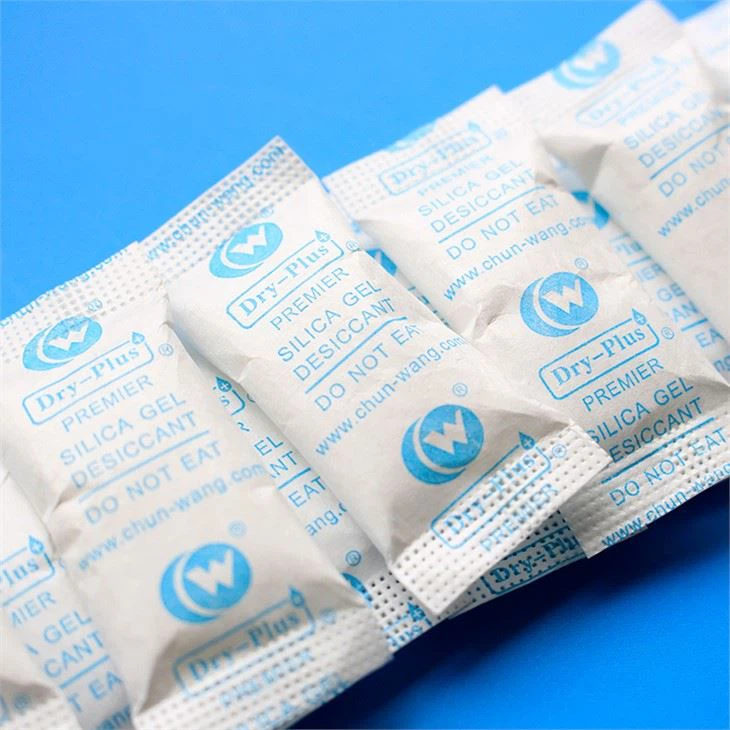
There is no fixed number, because a sachet does not wear out: it fills up. Silica gel adsorbs up to about 37 % of its own weight in water, so a 10 g sachet holds roughly 3.7 g before it stops working. How fast that happens depends on three things.
- The enclosure volume. The air in a 1 L box at 25 °C and 90 % RH carries about 20 mg of water. A sachet would take years to fill on that alone. The volume matters only because it sets how much air is exchanged at each cycle.
- The leak rate, meaning how much the box breathes. An IP65 or IP67 enclosure is tight to liquid water, not to air. Every day the air inside warms and pushes out, every night it cools and draws humid outside air back in through the seals and glands. Each cycle brings a fresh load of water vapour that the sachet has to take. We described this in IP65 enclosures breathe. The more cycles and the larger the temperature swing, the faster the sachet fills.
- The climate. Nightly humidity near saturation and large day/night swings, which is the ordinary weather of a coastal or continental site, bring the most water in. A dry indoor cabinet brings almost none.
Put together: in a sealed outdoor box with a daily thermal cycle, a sachet sized for the volume typically lasts from a few weeks to a few months. The figures suppliers print on packaging assume a closed, non-breathing volume, which a field enclosure is not. In practice, on a deployed fleet, the sachet is never replaced, because nobody comes back for a consumable that costs less than a euro. The equipment then runs for years with a full sachet, which is the same as no sachet.
Can you reuse silica gel?
Yes. Silica gel is not consumed by adsorbing water; it is dried again by heat. Suppliers give a reactivation range of about 120 to 150 °C for one to two hours, after which most of the capacity is back. That is what a rechargeable desiccant is: ordinary silica gel, often with a colour indicator that turns when saturated, sold with the instruction to bake it. Some canisters are designed to go in an oven as they are.
Three limits apply.
- The recharge happens outside the enclosure. You have to open the box, take the desiccant out, bake it somewhere with an oven, and bring it back. On a bench that is a chore; on a mast, a roadside cabinet or a charging station it is a site visit, and the visit costs far more than the desiccant.
- Capacity fades with use. Beads crack under thermal cycling, dust and oil vapours clog pores, and each cycle recovers a little less. Suppliers do not promise a cycle count; in practice the limit is the number of visits you are willing to make, not the material.
- Between two recharges, it behaves like a disposable. It adsorbs until full and then does nothing. In a box that breathes, that point comes in the same weeks to months as above.
So reusing silica gel is a good habit for packaging, storage rooms and lab desiccators, where the desiccant is at hand and an oven is nearby. It does not change anything for a sealed enclosure in the field.
Rechargeable is not the same as self-regenerating
The words are used loosely on product pages, so here is the distinction that matters for an enclosure.
A rechargeable desiccant needs an external action to be used again: heat from an oven, applied by a person, outside the box. Between two actions it is a disposable with a longer story.
A self-regenerating desiccant releases the water it captured without any external action. The SRD material is a mesoporous alumina, an aluminium oxide with a pore structure in which water vapour condenses by capillarity above roughly 60 % relative humidity and evaporates again when the humidity drops. Inside a sealed enclosure that is exactly the daily cycle: the sticker takes water during the cold, humid night, when condensation threatens, and gives it back to the air during the warm afternoon, when the air can hold it. The cycle repeats indefinitely, at ambient temperature, with nothing to power and nobody to visit. The material and its adsorption curves are described on the material page, and the comparison of the underlying materials in Activated alumina vs silica gel.
The consequence for the word “lasts”: a self-regenerating desiccant has no saturation end point in a cycling enclosure. It is reusable in the strict sense, without being rechargeable, because there is nothing to recharge.
What it costs over five years: one worked example
Illustration with stated assumptions, not a quotation. Adjust it to your site.
Assumptions: one 20-litre outdoor enclosure on a site that needs a technician visit to open; the disposable sachet replaced twice a year; the rechargeable desiccant removed, baked and refitted twice a year, which is the same two visits plus oven time; AS-B sized at one sticker per litre.
| Option | Year 1 | Years 2 to 5 | Five-year total |
|---|---|---|---|
| Disposable sachets | 2 sachets, 2 visits | 8 sachets, 8 visits | Sachets negligible; 10 technician visits |
| Rechargeable desiccant | 1 canister, 2 visits, 2 oven cycles | 8 visits, 8 oven cycles | Desiccant negligible; 10 visits plus 10 oven cycles |
| AS-B stickers, 20 units | 20 × 1.75 € = 35 €, fitted once | 0 € | 35 €, no visit |
The desiccant is never the cost. The visit is. On a fleet of a hundred enclosures, the two disposable lines mean a thousand visits over five years; the third line means none.
When each option is the right one
- Choose a disposable pack for shipping and packaging, where the volume is closed for a few weeks, the sachet is thrown away with the packaging, and the unit cost is what matters. Silica gel and clay are unbeatable there.
- Choose a rechargeable desiccant for a desiccator cabinet, a storage room or a bench instrument, where the desiccant is at hand, an oven is nearby, and a colour indicator tells you when to bake it.
- Choose a self-regenerating desiccant for a sealed enclosure in the field, under 100 litres, that breathes with the weather and that nobody will reopen: sensors, cameras, meters, telecom boxes, charging stations, robots. The AS-B sticker is that format, one 50 × 20 mm sticker per litre. Above one cubic metre, cabinets, shelters and containers, the same material comes as the AS-C ribbon.
- Where a heater is already fitted, the passive desiccant covers the unpowered hours; the trade-off is in Enclosure heater vs desiccant.
What the tests say
In a climate chamber, three identical IP66 enclosures went through a 30 to 0 °C cooling ramp: the empty box fogged, the box with a breather vent fogged, the box with the SRD sticker stayed clear. The protocol is in Gore-Tex vent vs SRD AS-B, climate chamber test; the silica gel comparison under extreme condensation is in Silica gel vs So Sponge AS-B. On an autonomous agricultural robot, a silica gel sachet and a pressure compensator were already fitted and were not enough; the sticker removed the residual moisture. On a 0.6-litre IP67 camera enclosure, 48 hours at −1 to +3 °C and 90 to 94 % RH left glass and optics dry with a single 10 cm² strip. Both field cases, with protocol and results, are on the validated use cases page; no customer is named.
How we compared, and our position
So Sponge manufactures the SRD material compared here, as the AS-B sticker and the AS-C ribbon. Silica gel figures (capacity up to 37 % of its weight, regeneration at about 120 °C for 1 to 2 hours, reactivation range 120 to 150 °C) come from the public references below. The “weeks to months” lifetime in a breathing enclosure is an order of magnitude from our own tests and customer feedback, not a supplier figure; suppliers’ printed lifetimes assume a closed volume. The five-year example uses the assumptions stated in the text. This page will be revised when better public data appears.
Related comparisons: Activated alumina vs silica gel · Enclosure heater vs desiccant · Gore Vent, breather vent or desiccant breather · Silica gel: the blind spot of industrial eco-design · All anti-condensation solutions compared
Order AS-B online, from €100 excl. VAT
Sources
- Wikipedia, Silica gel: water capacity up to 37 % of its weight, regeneration at about 120 °C for 1 to 2 hours
- Ted Pella, Silica gel desiccant, technical note: reactivation by heating at about 120 to 150 °C
- So Sponge, self-regenerating mesoporous material: material page, climate chamber test on three IP66 enclosures and validated use cases